Letters from Russia
Part 1
The first time The Salvation Army officially worked in Russia was at the beginning of the 20th century, from 1913 until it was prohibited on the grounds of anti-Soviet activity on 27 February 1923. It was ten years in a turbulent period. During the ten consecutive years that The Salvation Army was in the country, the work developed.
Earlier, in the years 1910–12, the Danish officers, Lieutenant-Colonels Jens and Agnes Povlsen, lived in Saint Petersburg for 18 months and shared the Gospel as best they could, visiting people in their homes while also working to obtain permission for The Salvation Army to work officially in the country. They had previously, from 1898 to 1903, been leaders of The Salvation Army in Finland, which was a Grand Duchy under the Russian Tsar, and through this had gained insight into Russian rule and Russian conditions. William Booth visited Saint Petersburg in 1909 and established contact with people in the government. From this he gained the impression that it might be possible to begin the work in Russia.
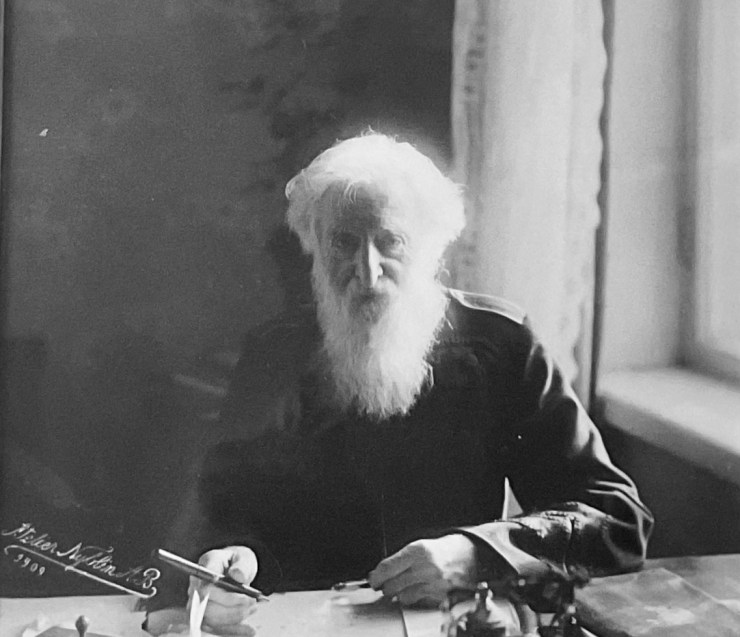
William Booth in Finland just before leaving by train for Saint Petersburg 1909
There were evangelical currents among parts of the aristocracy in Saint Petersburg. They knew The Salvation Army’s work from elsewhere in Europe, either personally or through family members. The first contacts were with people from these circles. Agnes Povlsen wrote in a later article about these months:
“We were invited to lead The Salvation Army meetings in several rooms that they had prepared. A Princess G., who used to play the piano for us, we called our bandmaster, while others who helped to speak and pray with people were nominated ‘penitent-form sergeants’. They seemed pleased with their titles. We could never appear publicly as The Salvation Army, but people seemed deeply moved by the spirit and message of The Salvation Army and came in large numbers: poor and ignorant men and women, unable to read or write; young, eager students who were desperate about their country; thoughtful and proud people – but also so sadly so; pale, thin children from the damp, filthy and dark basements of the city’s slums. Their faces would light up and their bodies sway from side to side when they joined in the Russian translations of choruses such as ‘Let God’s warm sunshine in’ or ‘No, never alone’. As we gradually became able to speak a little with them in their own language, they were delighted.
The visits we made from door to door among the working class and in the slums gave us some insight into the terrible conditions in which the population lived.”
Prime Minister Pyotr Stolypin was carrying out some reforms of Russian society, especially an agricultural reform from 1906, but he was killed by a terrorist in Kyiv on 18 September 1912. It was the work on social reforms and the greater openness that gave reason for optimism about a possible opening for The Salvation Army, but the answer was no to opening The Salvation Army’s work in the spring of 1912.
The year after the Povlsens had had to leave Russia, a new opportunity arose in June 1913 because of a large exhibition on health in Petrograd (Saint Petersburg), where Finland, which was part of the Russian Empire, naturally had a pavilion. At the exhibition, The Salvation Army could show some of its social work. From this, ideas developed about how a foothold could be established in the city. Colonel Karl Larsson, who was the leader in Finland, was central to this process. First, permission was obtained to publish the magazine ‘The Salvation Message’, and magazine sellers could obtain permission to be in the country. At first there were two Finnish officers, Captain Elsa Olsoni and Lieutenant Henny Granström, and gradually more, up to ten. The sale of the magazine led to conversations with people and home visits. People also came to where they lived, and parlour meetings were held there – officially tea parties, since public meetings were not permitted. The samovar was always on the table. Soldiers were enrolled and listed as soldiers in a Helsinki corps.
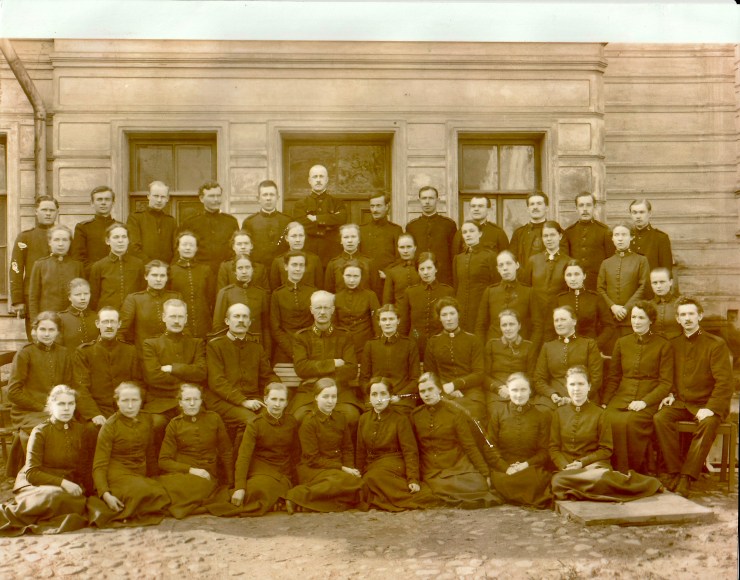
Colonel Carl Larsson and wife gathered with officers and cadets for Congress in Russia
There was great joy in 1917 and 1918, when there was freedom to gather, even in the open air. A training college was opened with 18 cadets, and a congress was held. At that time there were several corps in both Moscow and Saint Petersburg, plus two orphanages and a slum station. But already towards the end of the year there was persecution, arrests, cholera, hunger, illness, lack of heat – lack of everything. They struggled through the following years; the orphanages were taken over by the local authorities or closed, and some of the children stayed with the officers. The officers had to try to find work in hospitals, the postal service, and some of the Russian officers had to return to their home regions. The Swedish officers were expelled. The authorities’ policy fluctuated, so things were closed, after which they were nevertheless allowed to hold meetings. In 1920 there were 15 officers left. There were arrests of officers and local officers in the first part of 1921 and 1922, but they were released from prison again after some weeks or months, one of them after eight months. From April to November 1922 there was suddenly a period of freedom to work and a feeling of liberty, but then in November the premises in Moscow were closed and at the beginning of December those in Petrograd. The last officers were given the opportunity to leave, including five Russians, who continued working as officers in Finland or other countries. On 27 February 1923 the final official closure of The Salvation Army took place. It was liquidated for anti-Soviet activity. During the spring, Major Elsa Olsoni left the country. During the last couple of years she had worked with the Finnish evacuation commission. The first officer also became the last.
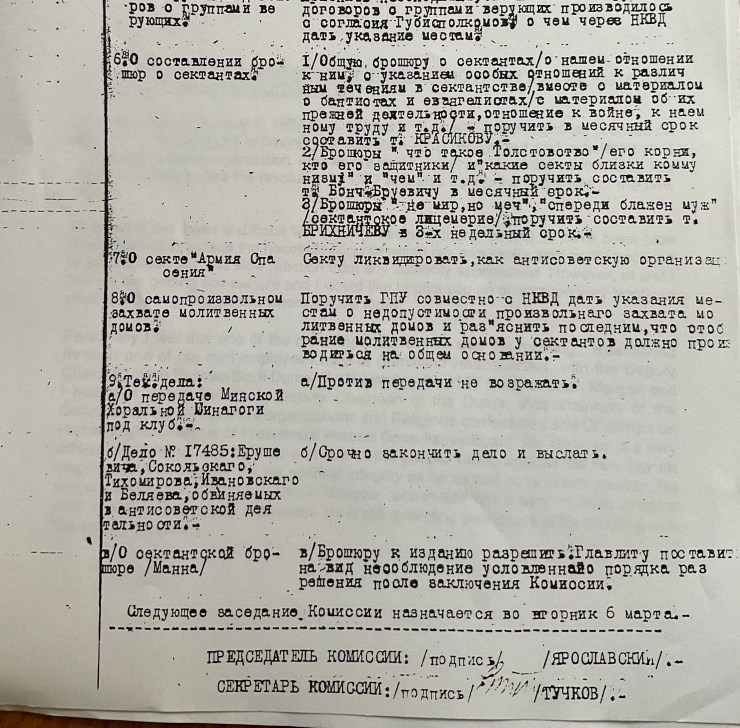
The protocol of the Centralcomitte meeting on the 27. February 1923 – §7 banning Army Spaseniya (The Salvation Army) for anti Sovjet activities.
Here are some excerpts from letters from officers sent to Finland. This is from Lieutenant Klara Becker dated 16 September 1920[1]:
“It is midnight, and the air is heavy because of an approaching thunderstorm, and any thought of sleep is impossible. I ask myself, what will the outcome of it all be? But as I ask the question, the answer comes: ‘My grace is sufficient for you’. I trust in the Lord and know that it will be so. Nevertheless, when this letter reaches you, you must pray for us and especially for her who is our leader here – for her room at the moment seems to be the place where lightning may strike. ……. During the following days we packed and left for Petrograd. Major Hacklin had already arrived. Here that winter seven adults and five children (the remaining children from our orphanage) lived in a six-room apartment. Captain Granström and I shared a room. She had work at a hospital. Captain Korhonen worked at another hospital, responsible for the instruments in the operating theatre. Captain Beleffsky and his wife also live with us. They regularly go out into the countryside to obtain food and hold meetings.”
Another letter from Moscow dated 14 February 1921 from Captain Konstantinoff tells of meetings every evening and two on Sundays, with the hall full most of the time: “We now have 21 soldiers and 5 local officers; in addition, we have 20 recruits who will soon be enrolled as soldiers, while from the 350 new converts, a number will become recruits. From time to time we go out into the countryside. The comrades are inspired and full of zeal. We feel that we are living on a volcano, but with the unknown ahead of us we are able to endure. (The volcano erupted, and officers and soldiers in Moscow and Petrograd were sent to prison).
From 1917 and the following years, very many Russians began to leave the country. They were people with property and education, in short the nobility, the bourgeoisie or civil society. Some of their buildings or money were given to The Salvation Army. When they were outside Russia, International Headquarters in London gave money to some of these people in exchange for the Russian money they had left with The Salvation Army.
A new chapter for The Salvation Army in Russia
Part 2
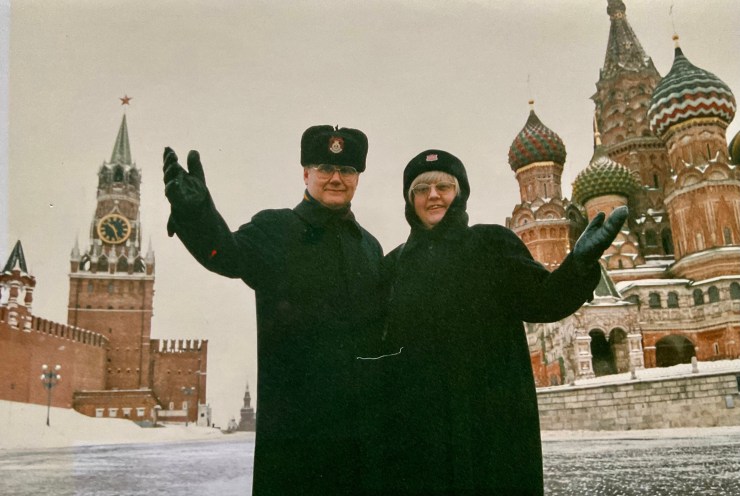
68 years later, The Salvation Army’s work in Russia began again. This happened on 1 June 1991 in Saint Petersburg. It quickly spread to Moscow and throughout the country, to lively and committed corps and social projects. In both Saint Petersburg and Moscow, several corps were established in different districts. In Saint Petersburg, The Salvation Army in Norway sponsored a large social centre working with homeless people, both children and adults, with doctors, corps activities and social initiatives in the city.
In the 35 years that have passed since then, the work has spread to Ukraine (1993), Georgia (1993), Moldova (1994), Romania (1999) and most recently Bulgaria (2021). Here is a vibrant Salvation Army, which in 2001 was organizationally separated from Russia and formed the Eastern Europe Command, further developed as the Eastern Europe Territory in 2005.
Russia, where The Salvation Army was closed down and prohibited just over 100 years ago, is today a completely different country. There were 70 years of Soviet rule, which ended 35 years ago. Much happened after the dissolution of the Soviet Union, with freedom and democracy and, not least, the various independent states that re-emerged. Over the last twenty years, however, things have slowly changed, with steadily less freedom. Since 24 February 2022, when Russia’s full-scale war in Ukraine began, the country has lived in a state of war. In connection with this, there has been a brain drain – journalists, writers and young people have left the country because of growing repression, arrests and violence, either voluntarily or out of necessity.
100 years have passed, and the situations are different, but it is thought-provoking that there are also similarities, especially with the many resourceful people who have left the country and been granted asylum in other countries, as after the revolution in 1917. The increasing control and suppression of the population’s freedom can also be compared with Soviet rule.
The majority of Russians, probably also members of The Salvation Army, today live in a propaganda environment with alternative narratives that have been created, and with not much knowledge of the actual circumstances unfolding. Knowledge that has become increasingly difficult to find. I do not know what the future will bring when it comes to The Salvation Army’s members in Russia when the war one day ends. For now, they gather for worship as a Russian network or religious community under another name and without international connection. This time, The Salvation Army, as part of the international Army, has been in the country for 35 years.
We were in the leadership of The Salvation Army in the years 1997–1999 and wrote a number of letters and articles about the work in Russia, Ukraine, Moldova and Georgia. This material provides a good insight into conditions during these important years, when The Salvation Army’s presence was consolidated after the first six years of pioneering work.
Excerpt from an article I wrote[2]: “The Salvation Army, like much else, helped to fill the vacuum that arose after the fall of communism. The Salvation Army was once again invited into the country by authorities and various groups after almost 70 years of involuntary absence. From the very beginning it sought good relations with existing churches and visited the hierarchy of the Orthodox Church. The tasks seemed overwhelming, and there was a need for all good forces.
People came into contact with The Salvation Army through open-air meetings, by seeing the uniform in the street, by hearing about events through advertisements and noticeboards. Many came to our worship services and events. There were many reasons for this; curiosity was one of them. Here was something new and unfamiliar, there were people from abroad, so there was an opportunity to hear and speak English, and there was different music. Everything was held in familiar buildings, cultural palaces, schools, libraries and so on. The Christian faith was preached in a simple and straightforward way, and the Bible was central. The emergency relief and engagement with social problems from the beginning also played a role. Many wanted to take part in this work and express their often newly acquired faith in a practical way.
Some joined the Army after having been employed as interpreters, secretaries or relief workers. Others came into contact through family, friends and colleagues. It is fascinating to hear how people came to faith, and why they chose to practise their faith within the framework of The Salvation Army.
It is an experience to hear people who were employed as interpreters and secretaries, without any Christian background, tell how it was to interpret sermons, read the Bible, and be present when a prayer was said with people or translate a ‘God bless you’. It became a personal call to conversion.
The majority of the people one came into contact with had a completely atheist background without any connection to a church. Others with different church backgrounds, both Orthodox, Baptists and people from Pentecostal churches, chose to join The Salvation Army. Among the reasons were its strong social commitment, the form of worship, equality between men and women at all levels, the music, or simply the central role of laypeople. This seemed to weigh more heavily than in-depth theological considerations.
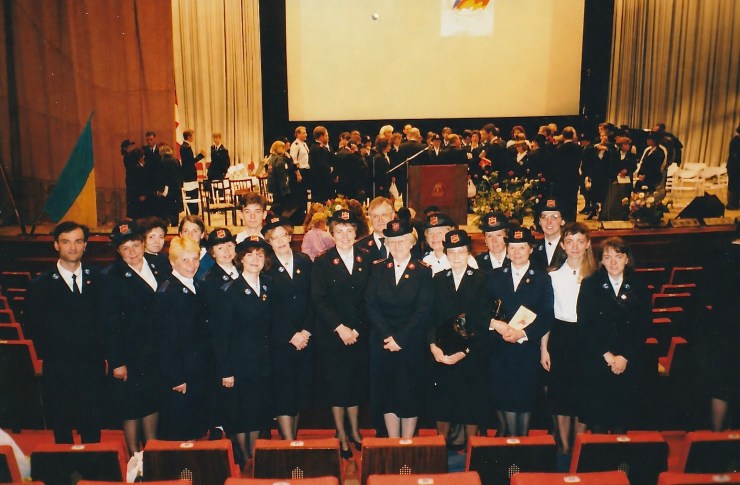
Today the interest in the novelty is over, and the foreign element is neither as overwhelming nor as attractive. To a large extent it is a Russian Salvation Army that is in a process of stabilization and transformation, with quite a solid influence in the cities where it is present. Many recognize the uniform when they see it in the street, and growth takes place quietly and steadily on the basis of the work being carried out.”
In 1997 the reopening of the Salvation Army were celebrated at a well attended Congres in Moscow
The Religious Law of 1997
On 26 September 1997, a new religious law came into force in Russia, the Law on Freedom of Conscience and Religious Associations, signed by Boris Yeltsin, Russia’s then president. He tried to veto it once, but had to sign it the second time. The law was a reaction to a law of 25 October 1990 signed by Mikhail Gorbachev, which had granted extensive freedom to various forms of worship.
The new law introduced stricter controls and favoured the Russian Orthodox Church. It placed major restrictions on the work, but at the same time it was interpreted fairly freely. It was like an elastic band, opening up for both very restrictive interpretations, as now, and more liberal ones, as in the years when we worked there.
The 1997 law has been tightened significantly through numerous amendments (the 2016 Yarovaya package, the 2017 ban on ‘extremist’ groups, and 2021 restrictions on leaders and foreign ties). There has been increased pressure on Protestant churches through surveillance, searches and judicial bans under the pretext of prohibiting missionary activity. The original legislation has been transformed from regulation of religious communities into a strict instrument of control that effectively suppresses religious minorities.
Letters concerning the religious law
This letter of 22 September 1997 concerning the corps in Saint Petersburg describes the uncertain situation: Both places were somewhat confused. On Sunday morning, the city authorities had announced that now that the law restricting religious freedom had been adopted, they would no longer have The Army hold meetings in the rented premises. The message was that the following Sunday would be the last time, despite rental agreements running until the end of the year.
It was good that I (Carl) was in the city to reassure the officers and soldiers. The law was passed in the lower house, where only 6 voted against. It is to be considered by the upper house of the Duma, the second chamber, during this week, and will be passed by an overwhelming majority. But it will not come into force until the end of 1999 and will apply from the year 2000. That Saint Petersburg is acting this way is not surprising, as the bureaucracy is like under communism, and we have had trouble elsewhere. I called Moscow and had the lawyers put on the case immediately.
It was not only in Saint Petersburg that the law was put into effect immediately. It happened everywhere, in fact, so we had to begin adapting to the law very quickly.
27 October 1997: On Wednesday we gathered all the officers from Russia for a meeting about the new law, where our lawyers were also present for the final part. There was a question period so that the officers could ask the lawyers their questions. It was completely clear to them that the overall aim of the law was to put an end to proselytism, so although an individual Russian has the right to believe whatever he or she wishes, there is not free rein to propagate one’s faith.
Children’s and youth work will probably be hit hard in due course if the lawyers are right in their interpretation that not even parental consent will be sufficient, because the state sees it as its task to protect children also against their parents’ wishes….. We have to try things out, because no one knows the interpretation of the law.
The War Cry and all other publications have been stopped. We will try to produce things in another way, perhaps via Finland.
All work in prisons and hospitals must stop, even if hospital management wants the work, but perhaps we can make some agreements that can function. ..there are many groups that do not wish to follow the law. We do not feel we can take that risk, because we want to remain in the country…. a lawsuit is almost impossible to win in these matters, because the judge is always right regardless of what we think the law says. Such a case could lead to a ban on the Army throughout the country, which must be avoided, hence the caution. Many expect the law’s hard line to first become apparent around 1 January 2000, which is the final deadline for submitting applications for registration under the new law’s guidelines. Others think it may happen earlier, or as soon as the matter disappears from the front pages of the Western media. We will have to wait and see. One thing is certain: it will be administered very differently in different parts of the country. That seems always to have been the case with Russian law.
We learned to live with the law and interpreted it as freely as we could in relation to the local authorities. A great deal of work then went into registration and into having the ten years of work in Russia before the 1923 prohibition recognized. This took place in archives in Saint Petersburg and Moscow. Letter of 21 January 1998: The work in the KGB archives here in Moscow has really been worthwhile. Many documents have been found, and the most important was found last week, the document that closed The Salvation Army. It was issued on 27 February 1923, and it says: ‘The sect The Salvation Army is liquidated for anti-Soviet activity.’ It is stamped with everything necessary. It is important evidence that The Salvation Army was present in the country and did not leave the country voluntarily. The many other documents show that the authorities kept a very close watch on the work both in Moscow and in Saint Petersburg. It is a long and arduous road to perhaps obtain registration giving us full rights as a religious organization that has been in the country for at least 15 years. All churches outside the Orthodox Church are designated as religious organizations.
I (Gudrun) went to Helsinki and worked with the archives held at Headquarters concerning the ten years from 1913–23. They were letters, accounts and supporting documents. I found a document concerning a contribution to The Salvation Army in Saint Petersburg from a duchess in the Tsar’s family. It came to play a role in the registration process. To obtain proper registration, The Salvation Army had to have been in the country for 15 years. The work succeeded. Here is a letter from 1 March 1999:
The big news of the week was that on Wednesday we were informed that The Salvation Army is registered in Saint Petersburg with full rights as a church. They have accepted all the years before and after the revolution and added them to the years we have now been here. This means that in Saint Petersburg we can now publish and do all the other things we could not do under the new law. We have had great difficulties here in Moscow; they will not recognize our application for registration, which also tries to include the revolutionary years when we were in Moscow. There is a tightening here and harassment of various religious groups.
The registration work succeeded in the following months, so The Salvation Army obtained an ‘all Russia registration’ – permission to work throughout the country. There was still the reservation that the law was interpreted differently in different cities. The fact that registration was secured meant that the work could grow and develop in the following years.
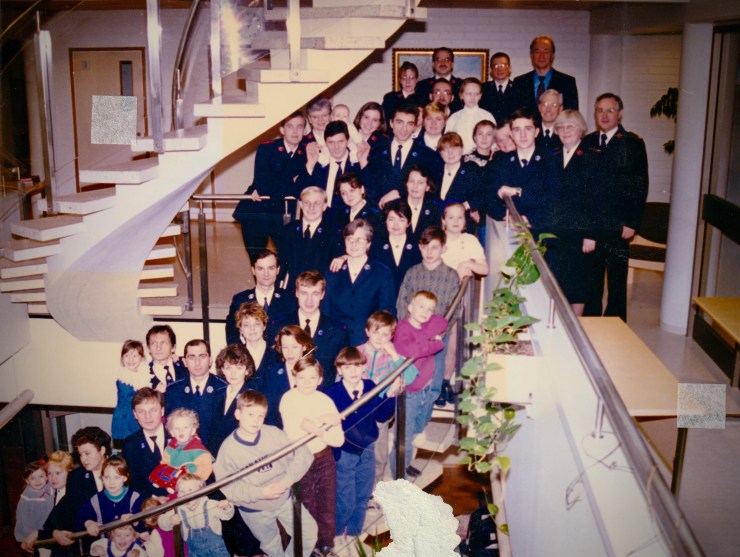
The considerable number of Russian officers who were trained together with officers from Ukraine, Moldova and Georgia for a number of years in Finland and later in Moldova did a very great deal of work during the years when this was possible, before the law began to be tightened further. The last years have been very difficult. The result, as mentioned earlier, is that a group of soldiers and officers gather for worship and the activities that are possible, as a religious community under another name without international affiliation.
The work developed, however, more quickly and broadly in what became the Eastern Europe Territory than it did in Russia, but in those countries there was and is also greater freedom and openness, without a restrictive religious law that could be tightened according to need or local conditions.
Impressions and glimpses from the work in the years 1997–99
The letters we wrote from Moscow provide an insight into the work as it unfolded in the years 1997–99. They are merely glimpses and not comprehensive descriptions. Not all corps and social initiatives are covered, but they nevertheless give an overall picture of the situation and the work.
Excerpt from the first letter from Moscow dated 21 August 1997, one month after our arrival: Last weekend we travelled south, almost 600 kilometres from Moscow to Voronezh. We were to speak and teach at a youth weekend. It took place at a holiday resort in a wooded area outside the city. The area was beautiful, but the building and the other buildings of the same kind in the forest were extraordinarily ugly and run-down multi-storey concrete blocks. There is incredible decay taking place. No one seems to care about maintaining or cleaning anything. Nature is being used as a kind of rubbish dump. It is terrible to see, because there are so many opportunities and resources that are simply being allowed to waste away.
The youth weekend itself was a really good experience. There were 92 young people aged 13 to 30, with the majority around 20. For us it is unusual to see so many young people completely concentrated on what is being said, while taking notes and afterwards coming over to ask questions.
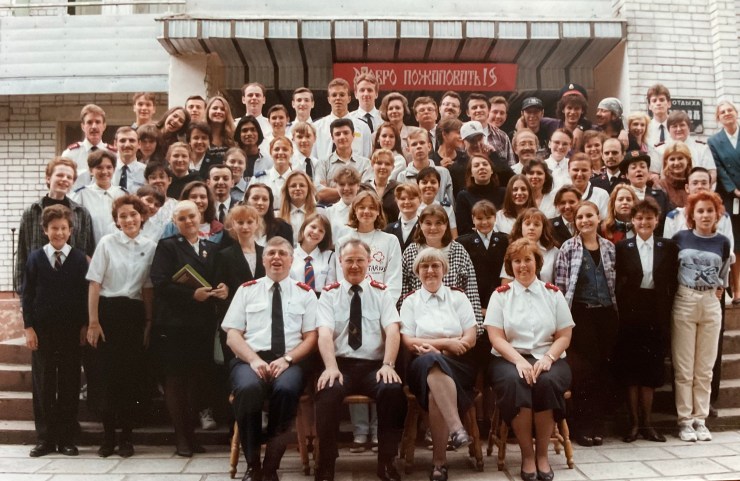
In the evening there was entertainment, a mixture of fun and seriousness. There is incredible talent that is well developed: fine musical performances, good acting talent and an openness and trust in one another. No one was afraid of being laughed at, and no one was laughed at. There was great seriousness and sincerity in prayer during worship services and devotions, an authenticity that was wonderful to encounter.
We travelled by car there and back. It was about ten hours each way. It was picturesque to see the landscape with the many small wooden houses in the villages and all the women along the road selling fruit and vegetables from their gardens. Most houses were very run-down, quite a few dilapidated, so life must be hard. All the churches we passed were either being renovated or had just been renovated. To me, all the gold and glitter on the churches was almost vulgar in comparison with the desolation of the villages around them.
Later from the same letter: Yesterday I (Gudrun) went out to one of the large stations and a park where we distribute food to homeless people. They look miserable, and they are being hunted by the militia at the moment. We cooperate with ‘Doctors Without Borders’, who have their vehicle next to ours at the food distribution point, so that each of us can do what we are able to do and refer people to one another. It is terrible to see the children who turn up. There were seven yesterday, three of them with their grandmother. They look as though they all live on the street, incredibly dirty. The youngest was a four-year-old boy. He drank his soup with a hunger that showed he had not eaten since we were there the day before. He was given extra and all the bread he wanted. He beamed as if it were a huge party. We always try to have fruit for the children that they can have after the soup. Funds are limited and food is expensive, so there is no money for plates and spoons. They come with cut-off plastic cola bottles (the large ones) and drink from them. We always have some plastic containers if the bottles they bring look unsafe from a health point of view, in which case they can have one. Food is distributed at two places every day in the middle of the afternoon. Great care is taken to clean up after the meal, so that there are no bottles lying around before the vehicle leaves, so as not to come into conflict with the ‘city’. Moscow will not acknowledge the homeless and tries to get them out of the city (with rather brutal means), especially with the 850th anniversary coming up in two weeks.
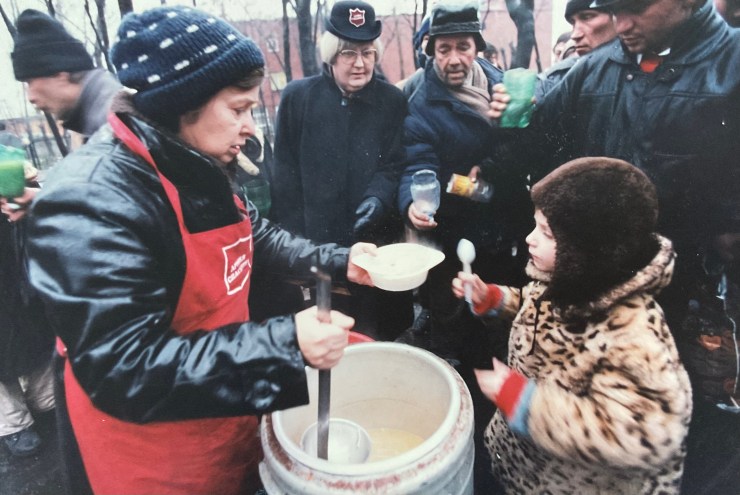
From a letter dated 8 October 1997: We have just hired someone who works exclusively on obtaining identification papers for homeless people, so that they can receive some help and remain in the city. Even something as simple as getting a photograph of them is difficult. He has been equipped with a camera so that he can take photographs for the papers. Many of them lost various limbs, mostly legs and feet, because of frostbite last year, and they are completely helpless without papers. They cannot get into hospitals, and if they have no papers, they are picked up by the militia and left in the forests outside Moscow.
Conditions for the homeless remained difficult, but it became possible to help some obtain proof of their identity and thereby receive help in hospitals for operations, wound treatment, etc. It was work that continued both with food distribution and help in obtaining identity papers.
Easter celebrations
Easter was regarded as the greatest holiday, with many traditions. There is Easter bread – a sweet bread with raisins. They were sold in the streets and at Metro stations, where grandmothers stood selling them. Here is a letter from 21 April 1998 concerning Easter:
The greatest tradition is the coloured eggs. People give them to one another, and great care is taken to colour and decorate them. The eggs are boiled in onion skins to obtain a deep brown colour, and the skins are collected over several weeks to have enough to produce the colour. Beetroot juice is used for a deep red colour, etc. You can also buy colours for decorating. Many of the eggs are incredibly beautiful.
On Easter Saturday we went to a monastery in Moscow. In the monastery grounds, people stood at tables where they had put out their Easter cakes and eggs. Two candles, which they bought at the kiosk in the monastery grounds, were stuck into the cakes, and they did everything they could to keep the candles alight. Around the cake lay eggs in all colours, some of them true works of art. There were hundreds of people. After we had been there for a while and walked around looking at the beautiful displays, a priest and two nuns came out, and the blessing of the eggs and cakes began. First, prayers were said over the water in a large plastic bucket, then it was poured into a smaller container, which the priest carried around. In his hand he had something resembling a bent paintbrush. It was dipped into the water while he chanted blessings and sprinkled the water over the fine things and over the people. Behind him the two nuns walked with a plastic baby bath each, into which people put cakes, eggs and money. They sang/chanted as well. As soon as the priest had passed with his water brush, people packed up their things, new people took their places, and the priest and nuns made the round once again. We were there for about an hour, but it apparently lasted for several hours, because people kept coming and setting out their things. There was great activity, and it was an experience to see the many beautiful eggs and cakes displayed.
On Sunday morning we were at the Lublino corps here in Moscow, in a district affected by high unemployment. It was wonderful to come to the meeting on this Easter morning. Everyone greeted one another with: ‘Christ is risen!’ and others replied: ‘Indeed He is risen!’ Afterwards people give each other three kisses, on one cheek, on the other and back to the first. I am learning it. The meeting began with the same greeting said three times, and there was a roar of voices in the response.
Here too there were plenty of coloured eggs and cakes for the communal lunch afterwards, as well as some to put into a beautifully decorated basket, which was later taken to a home for people with disabilities, so that they too could receive an Easter greeting.
It was a wonderful meeting with lots of children, young people and older people, about a hundred in all. The corps rents premises in a school in the middle of a residential area, and the office is also there. The corps has been here for 4–5 years and has a very good relationship with the school. All the children and teachers are used to seeing the officers and other helpers at the school every day, so they know the uniform. The rental income, which is very reasonable, apparently means a great deal to the school, because from time to time the head comes to ask whether the rent can be paid a few days early because they need money to repair a photocopier or something similar. It also means that there is great flexibility regarding the use of the premises. Overall there is good cooperation and helpfulness towards one another.
Such an arrangement could have been affected by the new religious law, but that is not the case here.
The work in Saint Petersburg
In Saint Petersburg, a large social centre was opened in August 1997, financed by The Salvation Army in Norway with funds from a television appeal. It was aimed especially at homeless people, both adults and children, with food, clothing, medical assistance and activities. In a letter dated 19 May 1998 I describe a Sunday meeting at the corps:
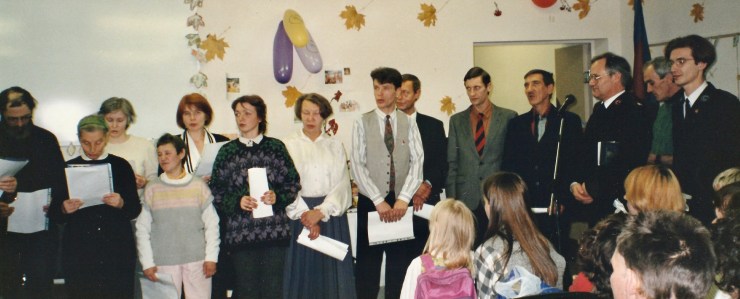
It was especially Sunday afternoon at the Mayak corps in Saint Petersburg that became unforgettable. It is a corps for homeless people, which opened in February in connection with our social centre there. (The centre was opened in August and was given and has continued to receive financial support from The Salvation Army in Norway with money from the television appeal there.) The premises were overcrowded, well over a hundred people, most of them homeless, of all ages from 8–10 years to around fifty. A soldier was enrolled, one of the staff members who is responsible for the work at the stations distributing food to the homeless. Seventeen became adherent members, fifteen young men and two women, all homeless. They had arrived three hours before the meeting to wash and put on clean clothes, and they looked smart. They performed mime to a Russian song. It was about the transformation in Jesus Christ in contemporary life. It was very expressive and astonishing to see their confidence and expressive mime. They have come to faith and expressed hope for the future, but their daily circumstances are still the street with the harsh conditions that homeless people face. They can come to our centre and take part in many activities there. There is a doctor employed, and there are opportunities for meals, but nights still have to be spent under bridges, by factory buildings, in abandoned ruins of buildings, etc. It was a wonderful worship service. It was difficult to see the homeless children, and I wish we could do more for them. They have fitted out the entire basement of the centre themselves with workshops and other activity rooms, but these are for daytime; the rest of the day and night are spent as best they can.
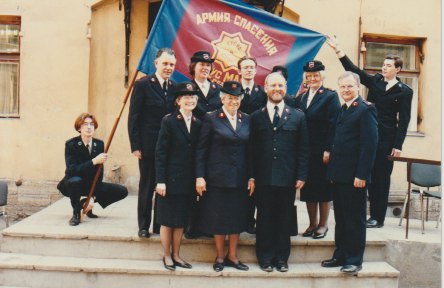
Genral Eva Burrows had a vision for Russia and after her retirement as the world leader of the Salvation Army she visited several places of activity and worship. Here with local leaders and staff in Saint Petersburg.
From the centre there were also visits to a hospital for small children with AIDS (from a few months to a couple of years old) outside Saint Petersburg in some wooded areas. The hospital was apparently preferably kept secret, since officially there were no people infected with AIDS in Russia. The conditions were indescribable, but with help from The Salvation Army in Norway, beds were purchased for all the children and two young women with some knowledge of childcare were employed. The hospital received this with joy, as there was a shortage of both beds and staff. Some young students from Saint Petersburg became volunteer ‘aunts and uncles’ and visited the hospital a couple of times a week to play with the children. Toys and other necessities were also purchased. When the children were one and a half years old, blood tests could show whether they were still infected. Some of those who were not infected were adopted by Russian families or foreigners who were in the country. The officer couple who led the work in the city adopted a little girl whom they had visited and cared for since she came to the hospital. Adoption became possible when she was nearly two years old. They were British citizens, so Natasja grew up in England, apart from her first years in hospital and in Saint Petersburg.
Times of crisis seen from Moscow
In a letter dated 21 September 1998 I describe the rouble’s free fall and the political unrest that arose at the beginning of autumn:
This is probably the most critical period since the end of the Soviet Union in 1991, and people have been nervous about tanks in the streets and about the future. They express this when you talk to them, but daily life continues regardless of the political game. For many Russians, political life and what goes on there is a kind of absurd theatre that does not really have anything to do with their lives. They do not place their trust in the country’s rulers, whoever they are. History has been a hard teacher, and unfortunately the lesson has been to turn one’s back on that part of social life and otherwise live one’s own little life and build networks around oneself in order to live and survive. The euphoria over freedom had long since passed when we moved here (in 1997); but the beginnings of a civil society and a middle class were very clearly visible here in the Moscow area, where they were strongest. People who could and had the resources worked around the clock with several jobs because they felt it was worthwhile and that they could give their children a better future. They still work, but the collapse of the banks has hit them hard. Those who had dollar savings have been told that they can get their money sometime in November, but only in roubles at a rate of 9.5. Yesterday the rate was 16, and before we reach November I am afraid it will be somewhere completely different, so the value of their money will be totally eroded if they get it. Others, who had wages in the bank and had put a little aside for clothes and shoes for the children’s start of school, have not received them. Schools and universities did not receive their materials because their bank did not pay out anything, so they could not pay for the materials. The problem is that some people had begun to trust the banking world and had opened bank accounts and other accounts, and now they have once again lost everything they had. The more sceptical, who learned from 1993 and 1994, when people lost everything they had, have at least had roubles with which to buy supplies for the winter.
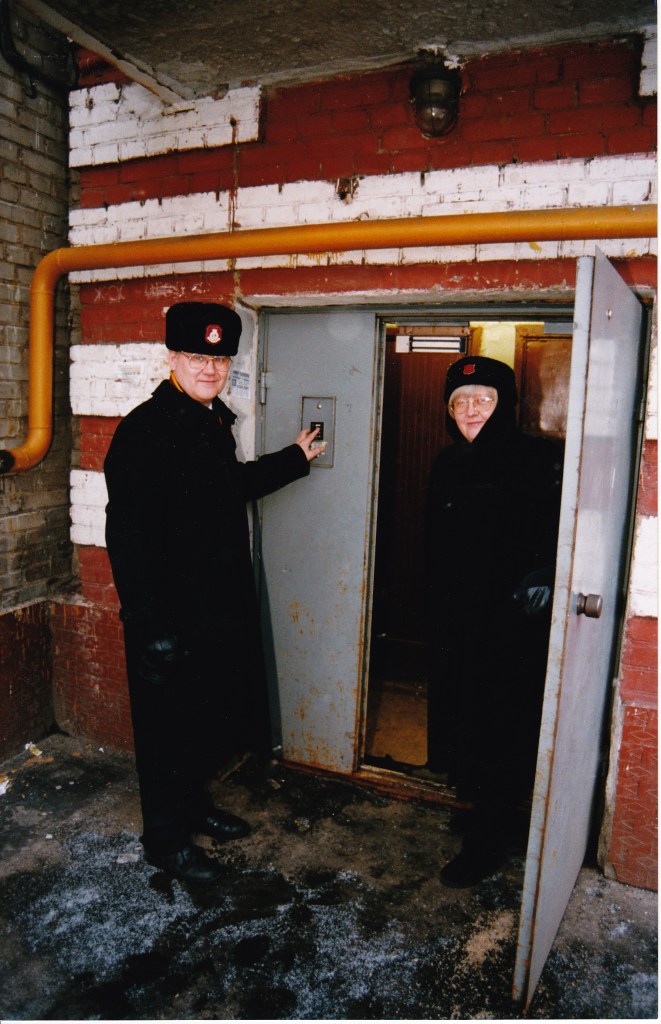
Outside Moscow and the large cities, people live in a subsistence economy, so the fall of the rouble has not had as much impact there. It is up to 80% of the population. They have not received wages or pensions for an age anyway. Here the potato is the currency, and it is what they live on. Potatoes, white cabbage, beetroot and apples, small cucumbers and tomatoes. They barter for milk and eggs or produce them themselves. There is not much meat in the daily diet. It is almost pure fat that is eaten; what they need to spend money on is sugar, which is used for preserving. They gather berries and mushrooms in the forests. The mushrooms are dried and the berries preserved. The vegetables are also preserved, except for potatoes, so along the roadside you can buy pickled cabbage, cucumbers, tomatoes and beetroot. What could become very serious during the winter is that the potato harvest appears to have failed in some areas. People grow potatoes everywhere, and that is what they live on. Even conscripts in barracks grow potatoes, and the military leadership has sent a letter to the various units around the country telling them to send the soldiers out to gather berries and mushrooms so that they have something to eat during the winter. They have no money.
We ourselves are developing new skills. We have never gone out to ‘look’ for money. We have made sure to keep a dollar ‘savings’ reserve for a situation like this, but we cannot buy things with dollars. Roubles are needed, and in many places they have run out of roubles. So we have sniffed around the city to find places where we could exchange money. We have even exchanged money ‘on the black market’ in the street. Our monthly rouble salaries disappeared like dew in the sun when we hurried to make necessary purchases of flour, rice, pasta and various foreign products that probably will not be available here for some time. It was also a completely new feeling to try to think long-term and buy the essentials, as storage space is not very large. The atmosphere when we went shopping about three weeks ago was almost like Christmas. People bought all sorts of things, and the shops were crowded. People shopped according to the philosophy that goods were better than roubles. They could possibly sell them on or obtain something they wanted or had been saving for, while the rouble still had purchasing power.
Well, that was a snapshot from Moscow.
On 7 October, nationwide demonstrations have been announced. They expect 30 million people to demonstrate, but the formation of the new government, which the communists regard as a victory for them, may mean that they will not whip the demonstrators up so much that it turns into riots. It will also be interesting to see whether they get down to governing the country or whether the theatre continues.
There were no riots, but it was a time of crisis both economically and in human terms. The government ‘limped’ on with a changing cast of people.
Visit to Petrozavodsk
In a letter dated 21 September 1998 there is a brief description of a visit to Petrozavodsk:
In July we visited Petrozavodsk, which is about an eight-hour drive north of Saint Petersburg. We travelled by train directly from Moscow. It took about 18 hours. It was an interesting journey, and we observed the landscape and people standing on the platforms selling berries and mushrooms, drinks and bread. When you see this, it is clear that Moscow is far away, i.e. the standard of living is much higher in Moscow, even though there are terrible things to see there as well. We have two corps in Petrozavodsk, and they are lively and full of children and young people.
The mayor of Petrozavodsk, incidentally, reacted calmly to the religious law and instructed the leaders in the city that leases and everything else could continue until January 2000, when the law came into force. Then they would look at the situation.
Further from the same letter:
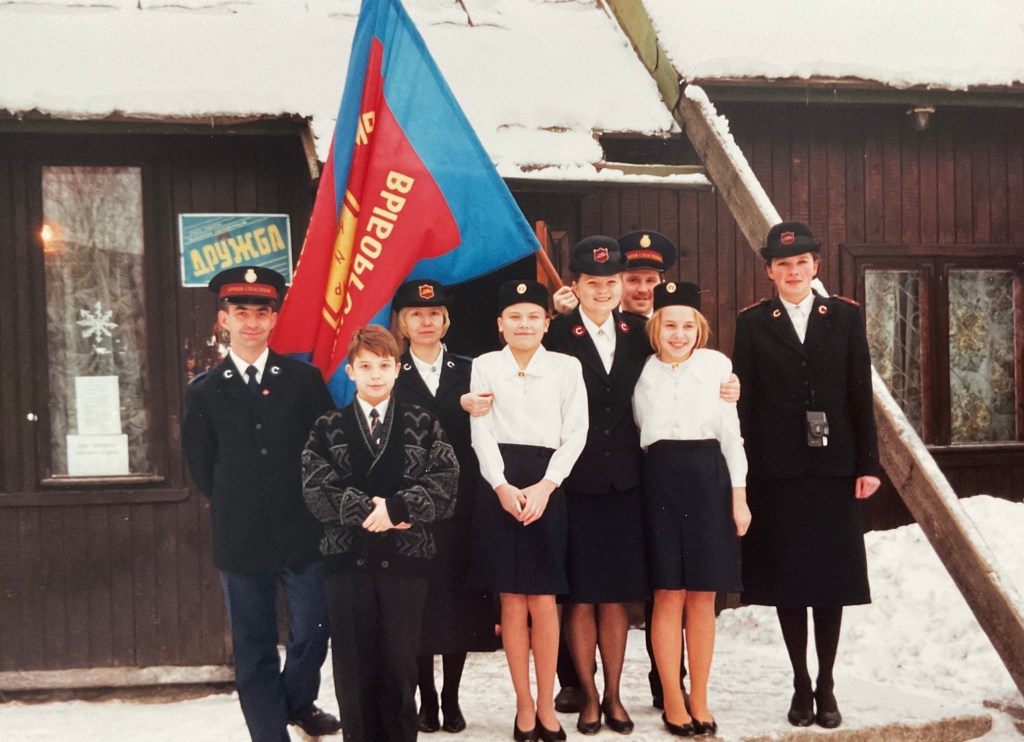
The Russian lieutenant, Julia, who led one of the corps, has now been sent to Vyborg on the Karelian Isthmus to open The Salvation Army there. It belonged to Finland until 1944, and there had been a strong Salvation Army there. At one point there were four corps and five social institutions in the city, where the divisional headquarters for Karelia was located.
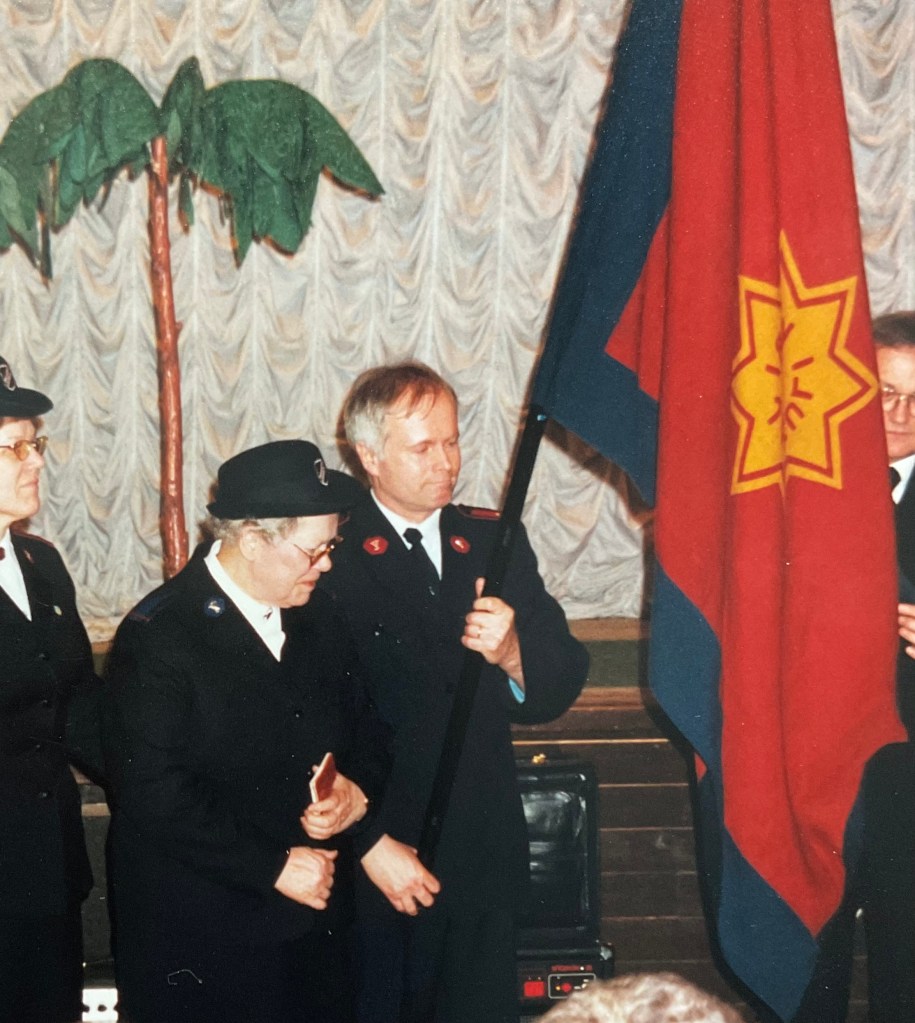
It was a Finnish population that lived there when the Soviet troops arrived in 1944, and they were driven into flight across the new border to Finland. Now it was a Russian population, but we thought it would be good to try to open The Salvation Army there in the city and see whether it could take root, and whether the Russian authorities would accept The Salvation Army’s presence in the city before 1944 as part of the registration work. A good corps was established in a residential area. We visited the corps at its official opening after a little over a year of pioneering work. At that time we were leaders in Finland. We travelled there by bus together with a group of Finnish officers, several of whom had family backgrounds in Karelia, including the last soldier who had been enrolled in the Vyborg corps before the invasion. She was 14 years old at the time. When we arrived there at the beginning of 2000, she was a mature woman, but very active in the Helsinki corps. We also brought the old corps flag from Vyborg as a gift to the new corps.
Volgograd
In a letter dated 21 September 1998 the plan for a visit to Volgograd is mentioned:
On Friday we are going to Volgograd to have meetings and seminars. We have not been there before, but the city has about one million inhabitants, and it is apparently badly affected by unemployment and industries that have gone bankrupt and could not cope with the transition. We have to see what things are like in this crisis situation. We are flying there on one of the ‘exciting’ domestic planes with room for about 20 people.
In a letter dated 21 October 1998 the visit is described:
The last weekend in September we were in Volgograd. It was the first time we had visited the city. We were quite impressed by our work there; but the city is simply ugly and run-down, lacking any charm. It is the old Stalingrad, which was completely destroyed in the winter of 1942. It stretches for 97 km along the bank of the Volga River and consists mainly of three parallel main roads running that length, with connecting roads. All the buildings are concrete slums, and the roads consist of more potholes than road. Gas and oil pipelines lie exposed and unprotected along the roads, and where grass should grow there is trampled earth, individual trees that look as though they survived a bombing, etc.
We have two corps branches in the city, both with large social programmes. The North Corps is located in a former kindergarten, where over the years we have invested so that it is in very good condition (by Russian standards). It is a large two-storey building. Every day there is a children’s/youth centre with all kinds of activities, including sports, as there is a large gymnasium with all the necessary equipment. We have a bus that collects disabled children and takes them to the centre, where they receive rehabilitation and activities. There is a senior centre and ordinary corps activities such as study groups, music groups and worship services. There is a large kitchen and two dining rooms where hot food is served every day to 100 people selected according to their financial circumstances. There are both elderly people and families with children.
The South Corps also has good facilities on one floor. It looks like a former restaurant or public canteen with good kitchen facilities. It has also been fitted out very well; here too there is a children’s and youth centre. To make full use of the schools, the children attend school in shifts, some in the morning and others in the afternoon. The children’s centre is open both morning and afternoon so that it can receive both groups of children. There is homework help and creative activities. The centre is closed between 12 and 14, because, as in the other corps, meals (hot food) are served then for 100 people, here almost exclusively families with children. There are also many corps events with music groups, study groups and worship services.
We experienced a great deal of commitment from officers and soldiers and very good ecumenical work. People help and support one another.
The description of the work and situation in Russia consists merely of excerpts from the letters we sent home to Denmark to friends and colleagues. There were many more corps; in Moscow alone there were four. For example, the work in Rostov-on-Don is not described in any letters, but there was a lively corps with many young people and extensive social work. The examples described give an impression of The Salvation Army’s engagement in Russia during the two years we worked there.
In the following years, there was both an expansion of the work in some places and a reduction and closure in others. For example, The Salvation Army acquired ownership of several buildings and staff residences, so that in some places it was no longer dependent on rented premises.
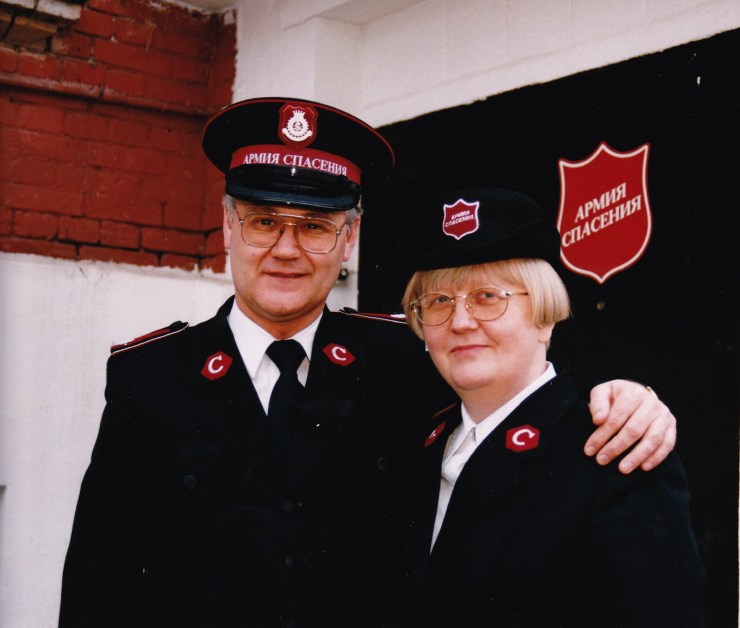
Summary
Part I, with the historical overview, gives a small insight into Russian history, which has influenced The Salvation Army’s opportunities in the country and which, to some extent, provides some background understanding of the situation today; in any case, there are points of similarity.
Part II gives some glimpses from the work during the two years when my husband and I were part of the leadership of The Salvation Army in Russia and the CIS countries. In the nearly thirty years that have passed since then, The Salvation Army has taken root in the country, but the religious law, with all the subsequent tightening and interpretations, has put obstacles in the way of the work. In particular, the years since 2022 have meant increased control and restrictions, which eventually made it impossible for The Salvation Army as an international church and organization to continue its work. The groups that still gather for worship and various activities are organized as a Russian religious community without The Salvation Army’s characteristics and without international affiliation.
[1] Her full name is Charlotta Mary Klara Becker. She was born on 25 April 1892 in Petrograd, where she was adopted by the solicitor Mr and Mrs Becker. She entered the training college on 2 June 1917 in Finland and, after her training, received her first appointment in Petrograd on 4 September 1917. She returned to Finland on 12 April 1922. She is one of the few Russian officers about whom we know what happened after they left Russia. She went on to work at International Headquarters in London as an interpreter and translator. As was customary for women from the upper levels of society, she had learned several languages; in addition to Russian, she spoke French, German and English. She was called ‘Translator extraordinary’, which is the title of a book about her.
I have no sources telling me what happened later to the other Russian officers mentioned, or about their backgrounds.
[2] Lydholm, Gudrun: Nordic Mission Journal, April 1998, pp. 9–10

