Writer: Gudrun Lydholm, Commissioner, PhD.
Commissioner Georg Scot Railton: “The Copenhagen Congress was undoubtedly by far the most important event in the Army’s history to date. For the first time Headquarters came away from England to confer in a foreign capital with the Army’s leaders in Europe. May the de-insulization progress! “
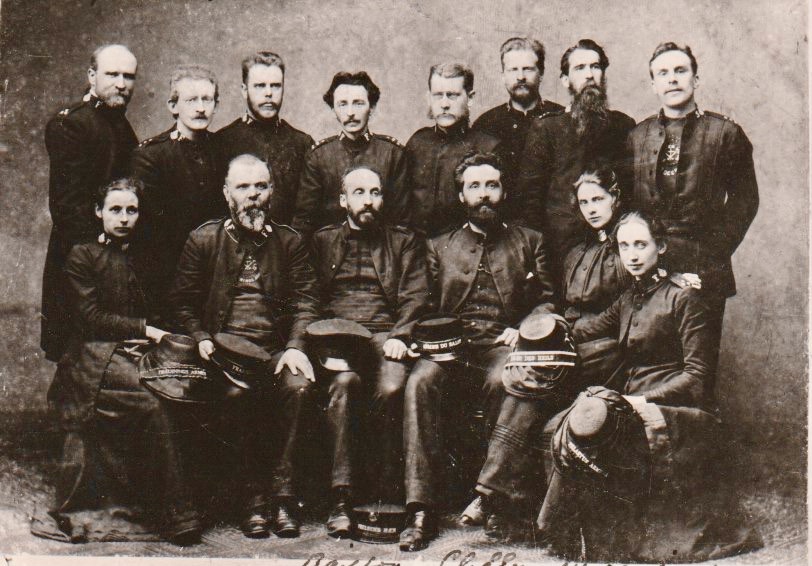
Some months ago I found a little photo in our private archive. It showed fourteen uniformed officers of which I recognized Commissioner George Scott Railton in the middle of the front row and Major Hedvig von Haartman in the same row. Of the people standing behind I recognized major Jens A.H. Povlsen, all three were early Army leaders from England, Finland and Denmark. Then I deciphered some handwritten names at the edge of the picture, Lagercrantz was one, Com. Oliphant another, Clibborn, Railton and mrs. Oliphant were the others. On the back it said Copenhagen. I wondered what these early Army leaders were doing in Copenhagen. And who the others in the picture were? I had to find out which sort of meeting it was, when it took place, a year and a date in order to make research in publications such as the War Cry, both the Danish and the English.
I searched history books with no result, but by an impulse of mine I turned to Soldier Saint[1] about George Scott Railton. Here I found that a North European Congress had been held in Copenhagen. It seemed to be in the spring of 1893, before William Booth’s second visit to Germany in the summer. By help from the Heritage Center in London I found the exact date 14th to 16th of April. This congress was the first staff congress outside England since the Army started its work. It represented 896 corps and 1800 officers of Europe and illustrated the Army’s growth and relevance into other cultures and languages of continental Europe.

The photo I had a copy of was on the front page of the Danish War Cry, Krigsråbet from these days in April. The names of all fourteen present in the photo were printed beneath the picture. This semi official or rather relaxed photo presented some of the leaders present at the congress, but far from all. General William Booth and the Chief of Staff Bramwell Booth, who were the leaders of the congress did not appear in the picture.
There were fifty staff officers from France, Switzerland, Holland, Belgium, Germany, Denmark, Norway, Sweden, Finland and Great Britain. The main staff officers were Commissioner Arthur Booth-Clibborn, Territorial Commander (TC) France/Switzerland, Commissioner Georg Scott Railton TC Germany and Staff–Captain Yonker and Gibson also from Germany, Colonel William Olifant TC and mrs. Celestine Oliphant from Holland/ Belgium and Major Walter Powell also from Holland/Belgium, Colonel Charles Sowton (TC) and mrs. Sowton, Major Jens A.H. Povlsen, Chief Secretary (CS) plus all the Staff and 112 Field officers from Denmark, Colonel R.W. Wilson (TC) and Staff-Captain Bergstrøm from Norway, Commissioner William Ridsel (TC), Colonel Emmanuel Hellberg (CS), Major Herman Lagercrantz and mrs. Hedvig Lagerkrantz, Majors Johan Ögrim and Jansen from Sweden, plus thirty field officers,. Major Hedvig von Haartman (TC) from Finland. Apart from the General and Chief of Staff, Colonels Pollard, Nicol and John Lawley came from Great Britain.
Who were the leaders in the photo[2]
Back to the photo and those who were in it, from left to right in the last row:
Major Herman Lagercrantz used to be an officer in the Swedish Military Army and served as a lieutenant at Svea Artillery Regiment. As a Salvation Army officer he served in different positions at THQ, in charge of personnel and organization, developing social work. At the time of the congress or during the congress he was appointed Chief Secretary in Sweden. He became ill with tuberculosis, but restituted and was appointed by the General as leader of the Army’s social work in India. This was only for a short while. His health worsened, and he and his wife had to return to Sweden where they resigned as officers. He became part of the diplomatic corps of the Swedish state and served for some years in Washington in this capacity. The family’s connection to the Army continued in the years to come.
Next to Lagercrantz is the Danish Chief Secretary (CS), Jens A.H. Povlsen. He met the Army in its first year, when he as a young student of Philosophy came to an Army meeting. During the congress he was translator for William Booth. A service he was called upon in the following years in whatever country he served, as he spoke seven languages. He served in Denmark, Sweden, Finland (Territorial Commander/TC), Russia (1910-12) the Army’s first attempt in pioneering its work here, Norway (TC) and finally as TC in Holland where he died on his 57th birthday. His wife Agnes Povlsen continued in international appointments in England and Sweden. In her retirement she travelled extensively leading meetings in different European countries and was also called upon from IHQ for special duties such as the Army’s representative to the League of Nations.
The next in line is Colonel Charles Sowton, TC in Denmark. He was English and had several appointments in England before he was send to the newly opened Norway as leader. From Denmark he became CS in Sweden, then sent to the Scandinavian work in USA for seven years, returning to Denmark as TC a second time. From here CS in Canada, followed by the same position in India and Ceylon. His last appointment was as Territorial Commander in Canada.
Colonel Richard W. Wilson one of the pioneers of the Christian Mission. He became an officer from Barnsley in 1881. At the congress he was TC in Norway and had previous been TC in Denmark. He became a Commissioner.
Colonel Emmanuel Hellberg, Chief Secretary in Sweden and a Swedish officer. During the congress he was given appointment to London to serve at the foreign office. The year after he married Lucy Booth. Straight after their wedding they sailed for India where Lucy became TC and Emmanuel CS. The Booth – Hellbergs were sent to France in 1896, where they stayed for eight years. They lost four children, one in India and three in France. After a period of sick leave Emmanuel died in 1909. Lucy continued as TC in Denmark for nine years, followed by another nine years in Norway and retired from active service in South America in 1934 after six years as a TC.
Major Johan Ögrim a Swedish officer at this time editor of the Swedish War Cry, from 1896 CS Norway for two years, then TC Denmark for another two years, Divisional Commander (DC) in England for five years (North England and later for South London and South England ), followed by service as TC in Finland 1903-06, Norway 1906-12, Sweden 1912-19 concluding his service as TC in Germany from 1919-1925.
Commissioner William Elwin Oliphant, a British officer ,Territorial Commander in Holland/Belgium. He was a minister in the Anglican Church and served as a curate of St. Paul’s, Onslow Square 1883-84, until he in 1884 joined the Army, trained as a cadet and became an officer. From Holland he became TC in Sweden, followed by Germany, and Switzerland / Italy.
Major Walter Mason Powell, standing at the end of the row was serving as Chief Secretary in Holland/Belgium at the time of the congress. He was a methodist local preacher, when he met the Army and became an officer in 1888. Subsequently to his service in Holland, he served in Norway, Japan, Northern India and Denmark. The remaining time of his officership he served at IHQ. He translated O mighty God, How great thou art to English from the Scandinavian languages.
Mrs. Hedvig Lagercrantz who is sitting in the first row from the left served with her husband in England for a while until 1889 and then in different fields of work in Sweden. She was in charge of Women’s Social work from 1896 to 1893. The couple had five children.
Commissioner William Ridsdel, who is sitting next to mrs. Lagercrantz, was a British officer, born in Catton, Yorkshire and Territorial commander in Sweden. He joined the Christian Mission in 1873 as an evangelist, previous to that he was a preacher for the Primitive Methodists in York. He stayed as territorial Commander in Sweden to 1896 and was later leader in South Africa, Norway and Holland.
Commissioner George Scott Railton siting in the middle of the front row was at the time Territorial Commander in Germany. He has a fascinating history from his early youth and onwards. When he met the Christian Mission he was a Methodist local preacher. He became secretary of the Christian Mission in 1873. He was very close to the Booth family, lived in the Booth household for eleven years from 1872/73 to 1884 and was instrumental in the creation of the military metaphor as well as in the Army’s position regarding the sacraments

He was very close to Catherine Booth in his theological thinking. He most probably created the sentence ‘Promoted to Glory’, which for the first time appeared in the War Cry 14 December 1882. He became editor (pro term) after having been called home to England from his pioneering work in USA in 1881 and kept this position for a couple of years[1]. In 1880 he pioneered the Army’s work in New York, established the Headquarters in Philadelphia and later in St. Louis. He travelled extensively, campaigning in South Africa, Holland, South America, the West Indies, the Far East, West Africa, China, Russia and Turkey.[2] Later (1901-02) he became Territorial commander in France.
Commissioner Arthur Sydney Booth-Clibborn is sitting next in the front row and at the time Territorial Commander for France and Switzerland. He grew up in the Society of Friends in Bessbrook, Northern Ireland, but was educated in France and Switzerland graduating from Lausanne University. When he met the Army in his home town he offered to help the Army in France. He went to Paris as an officer in 1881 and edited the French Army paper En Avant. In 1887 he married Catherine Booth ( La Maréchale) and adopted the name Booth-Clibborn. Together they compiled a French Salvation Army songbook in 1892. They served in France and Switzerland until 1896 and then took over Holland and Belgium as Territorial Commander. In 1901 he joined an American mission and resigned from the Army. He wrote over 300 hymns and songs.
Mrs. Celestine Oliphant ( born Schoch in Holland) serving with her husband in the leadership of Holland and Belgium. She has written a song which is in the Danish songbook of 1921 and 1948 number 134. After the time in Holland she served with her husband in Sweden, followed by Germany, Switzerland and Italy. In Wikipedia she is called songwriter and composer. She and her husband retired in Italy.

Major Hedvig von Haartman represented Finland as the Army’s pioneer and leader. The Army had begun four years earlier in this Grand Duchy of the Russian Empire. She was born on Radelma estate and was educated in Finland, France and Switzerland mainly in languages and was teaching French at a women’s college in Helsinki. An evangelical and social revival took place among the Finnish-Swedish nobility and upper class, but still contained within the Lutheran State church[5].
Hedvig von Haartman became part of this. The group heard of The Salvation Army and examined this new movement by visits in Europe and by personal connections. [6] Another of the leaders Constantin Boije and his wife was attracted to the Army as well. Hedvig von Haartman lived for a while in their home. A group of the these decided to contact William Booth in London and Louise of Forselles wrote a letter offering the Army to take over their movement and suggested that Constantin Boije, Hedvig von Haartman and Alva Forsenius should come to London to be trained as Salvation Army officers. This was agreed, and 9 April 1889 the group travelled to London. In the autumn they were commissioned as officers, Constantin Boije [7] as Captain and the two others as lieutenants. The opening meeting was 8 November 1889 in Helsinki. Captain Boije worked with the Finnish (Russian) authorities to find a model of organization for the Army which could be contained within the Finnish legal situation. This was a very difficult task and reason for contradicting views within the group. His time as a leader became short and he returned to his estate, but stayed a close friend and supporter of the Army. Already during late spring of 1890 Hedvig von Haartman was asked to take over the leadership, and in September she became adjutant and official leader of the Army in Finland. She stayed as leader in Finland until 1898 and went to Switzerland as leader for the German part of Switzerland. In 1900 she married a Swiss officer, Staff-Captain Franz Rudolf von Tavel, who before he met the Army had been a professor at the university of Zürich. Their service together became short as she died 15 October 1902.
It seems to be the only group photo from this congress and as mentioned appeared on the front page of the Danish War Cry, but was not used much in all the Army papers which otherwise wrote extensively about the congress. Instead of a photo most of the papers used a page with a number of signatures of the leaders, but again not all of them. The photo and the sheet with signatures give an impression of very good fellowship and a relaxed atmosphere between the leaders as a sort of ‘family gathering’.

The leadership in the different countries of Europe still reflected a British Salvation Army, as all the territorial commanders apart from Hedvig von Haartman were English, but leaders from the Scandinavian countries were emerging as the little presentation of the leaders in the photo illustrates.
The Army’s pioneer in Sweden, Commissioner Hanna Ouchterlony, who had been its leader for ten years since 1882 had been sent to USA in 1892 to encourage and lead the Scandinavian work. She also pioneered the work in Norway and had the overall leadership during its first four years (1888-92), even though the local leadership were in the hands of other leaders.
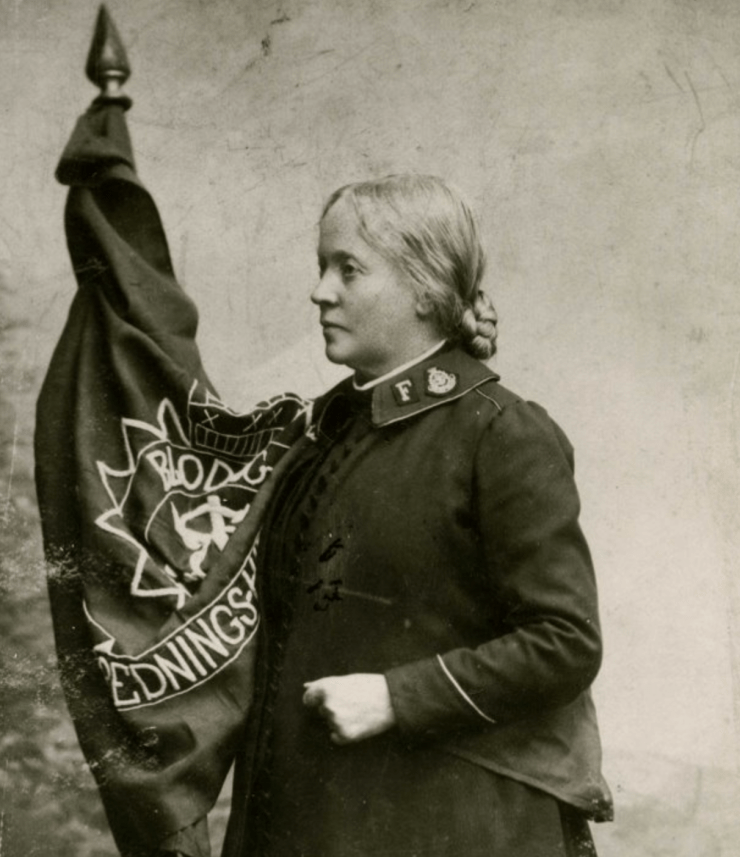
She was back in Europe at this time as representative from IHQ, but not at the congress. Already the year after in 1894 she became TC in Norway, a position she stayed in for six years until 1900.
Commissioner Railton’s comments about the congress in in All the World
Georg Scott Railton wrote extensively about the congress in All the World and concluded the last section in this way:
“The Copenhagen Congress was undoubtedly by far the most important event in the Army’s history to date. For the first time Headquarters came away from England to confer in a foreign capital with the Army’s leaders in Europe. May the de-insulization progress!
That it should be possible, in one of the smallest national Headquarters, and one of the smallest countries in the world, with therefore only very small staff, to have such a Congress arranged for and held without a single hitch, speaks volumes for the Army’s development. I never saw a Congress or Staff Council in London where arrangements were more complete or satisfactory in every way, and do not believe there ever can have been one held with so little that any one could wish better. The Army is undoubtedly becoming as perfectly organized for wholesale national agitation as God desires it should be; and this Congress has, I trust, in all who attended it, aroused grander hopes than were ever before cherished by the setting on fire of all nations with the Savior’s love.
Saving love was, of course, the all-pervading spirit of the campaign. That my dear German comrades should come back from Denmark above all impressed with the love shown them at every turn, is a triumph for the Army that no English reader can fully appreciate. This Army alone can abolish war![8]
As to the meetings, the enchanting thing to me was the prominence of the real, the original Johnny Lawley. It is common enough in Europe to run to hear any great preacher; but that the saved engine-lad should – leaning on a table-cloth generally used by the King of Denmark – lead a simple, proper Salvation Army prayer-meeting in one of the largest and most fashionable halls in the world, with a row of openly scoffing reporters to note the fall of the twenty-five penitents – that was the General and the Army’s greatest triumph to date. We shall see greater things yet, as we go straight on with this soul-saving!”
At this time Railton was no longer part of the inner circle of the Booth family and his influence on important decisions for the Army’s development had diminished, so his comments must be seen in light of this. The word de-inzulation reveals his attitude to what he considered the Army’s tendency of insulation which here is broken. I am sure he enjoyed the congress and felt it was very well organized, but the great praise is as much a ‘hidden’ critique of what is happening in London. He sincerely enjoyed that the Army on the continent was recognized. His comment on the Army’s development in organization has developed to the degree that it can successfully be planted in other cultures is interesting as well (‘wholesale national agitation’).
Article about the congress in All the World
The article in All the World had a short overview of the congress which follows: “A Council conferring upon matters purely connected with the operations of this vast force was, therefore, a necessity, and because of its geographical position, Copenhagen was chosen for the purpose. The eight territories embraced France and Switzerland, Belgium, Holland, Germany, Denmark, Sweden, Norway and Finland. Alle their Commissioners were present. The congress lasted five days[9], and was led, of course, by the General, who had the invaluable assistance of the Chief of the Staff. The whole range of Continental warfare was brought under review, the territorial leaders and their staff personally interviewed, and, in the short period stated, no less than eight Council settings and four public meetings were conducted, two of the latter having been held in the splendid Concert Palace, at which thirty-five persons sought salvation.
The Congress was in every way worthy of the occasion. Its deliberations were marked by the wisdom and guidance and unction of the Spirit of the Lord. At the final meeting, the Holy Ghost fell upon the Council, searching, purifying and baptizing. It was generally agreed that few Councils have been held at which the spirit of love and confidence in God and the Army’s future. As the purpose of this article is not a review, however, all that need to be here said is, that the Council was personally, educationally and divinely educational. The Commander-in-Chief got into the hearts of his officers. Questions chiefly concerning the war, and problems still unsolved, were discussed by experts on the ground most affected by them; while the prevailing faith of a roomful of men and women intent upon saving the world through Jesus Christ alone, brought such en influence that will serve as an inspiration for many days to come.”
Apart from the congress sessions for the staff officers and the mentioned official public meetings with the General and Chief of Staff, the visiting officers held meetings in four Copenhagen corps: Helgesensgade, Store Kongensgade, Zinnsgade and Kristianshavn as well as in the towns of Hillerød, Helsingør and Odense. Music groups – bands/string bands – came over from Sweden to participate in the different public meetings. The congress became a grand event for the Army in Denmark, as salvationists travelled to Copenhagen from all over the country.
Practical matters in connection with the congress
It was quite amazing that the Army who had only been in the country for six years, got a deal with the National Railways (DSB) to get a discount on tickets for all salvationists travelling to the congress. They got return tickets to the prize of single tickets. It was very well organized as the corps officers had to send lists of names of people travelling. This was send to DSB. The people traveling had a verification with them which they showed on the train in order for their single tickets to be stamped so it could be used as a return ticket.
Another matter, which the Danish Headquarters had to take care of, was to find lodgings for all the people from abroad as well as from the province. There were public appeals in the Army papers and by personal contacts. The international leaders were billeted by people from high society and other well to do friends of the Army. There must also have been a number of ordinary people as well as soldiers of the different Copenhagen corps. who opened their homes for Salvationists to use their couch or a mattress. It must have been a great task for all this to succeed, but it did.
The Norwegian War Cry Krigsropet published a number of very lively reports from the congress. One of them was of a train journey from Århus to Copenhagen. The editor of the paper, adjutant C. Hyllested[10] travelled the ten hour journey together with field and district officers. At each town down through Jutland, over Funen and Zealand, more officers joined the party. Everybody told about what was happening in their corps and towns, all the victories won. They were full of joy and had great visions for the future. Apart from all the stories from the work they sang and played as part of the fellowship on the train. The district officer on Zealand, adjutant Carl Breien even taught them a new song. When the train controller came and asked if everybody were from The Salvation Army, they assured him that was the case. When they realized that a member of parliament was sitting there as well and by their assurance had been included, he was welcomed among them. When they arrived in the evening at the central station in Copenhagen they were welcomed by major J.P. Povlsen, the Danish CS, adjutant Boisen[11], adjutant Markussen[12] and adjutant Nielsen[13] plus a number of salvationists. They were to bring them to their billets here late in the evening.
A ten hour train journey was short in comparison with the journey the General and his party took. They left Monday 10thlate night straight after a meeting. It was the General’s 64th birthday and it had been celebrated by a day of public meetings. The party took the route over Vlissingen (Ferry) to Hamburg – Kiel – Korsør and then train from here to Copenhagen. It must have been a 36 hour journey. During the month of March the General had been leading a major campaign of meetings in England, where the results in people seeking the Lord had been the best ever.
A similar campaign had also been in Denmark during March, and it was reported that 1003 people had been saved according to the Danish War Cry.
A grand welcome
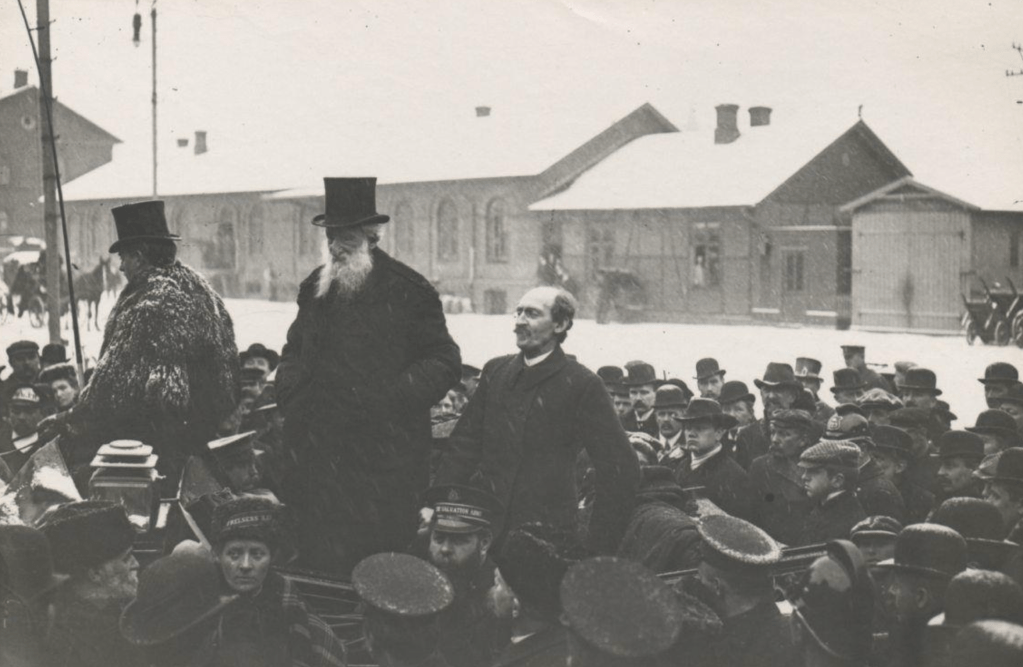
William Booth arriving in Copenhagen for an other occasion early 1900. It is winter but the founder speaks being translated by major Jens A.H. Povlsen
The morning of Wednesday 12th April at 10 am the General, the Chief of Staff, and colonels Pollard, Nicols and John Lawley arrived at the central train station. Everything was in place for a grand welcome. It was a great event for the territory. The station was full of life: officers, soldiers, a number of passengers and curious people from the city plus journalists from the papers, as it was a real Copenhagen event. The journalists were eager to get the names of the leaders arriving and those present to know who was who. The officers were lined up in two rows, the soldiers formed a trellis from the exit to the wagons. The Danish Staff Band played for a while to practice before the train arrived. Commissioner Railton with his German staff, Colonel and mrs. Olifant with the Dutch staff, Colonel Wilson with the Norwegians had arrived and were part of the welcome committee. The daily Newspapers gave an account of this the following day.
The welcome meeting Wednesday evening at the Concert Hall[14]
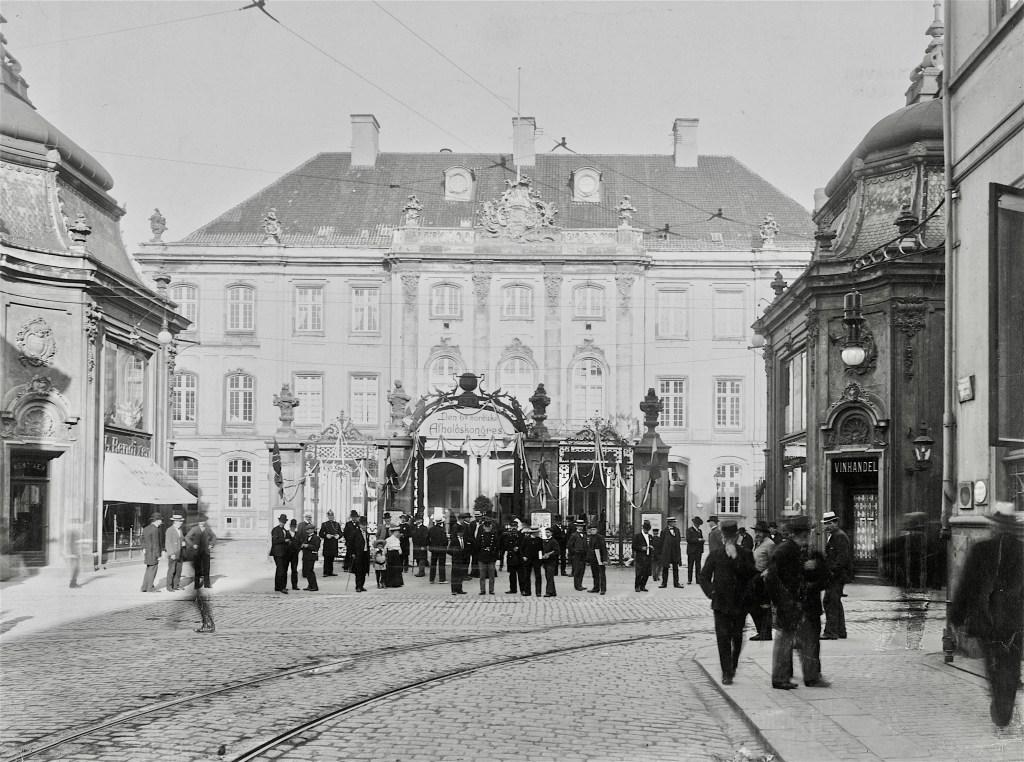
The War Cry from 22 April 1893 had as all the papers from the different countries extensive reports from the congress. I will use the vivid report from the War Cry:” I counted nineteen carriages, at the door of the Concert Hall while waiting the arriving of the General’s. These brought two ladies from the King’s court, officers in his Majesty’s navy and army, doctors, lawyers, ministers, missionaries etc. Ladies came in evening dress, provided with fan and opera-glass. In fact, the grandeur and swelldom of the city of Copenhagen were surely never more richly represented at a salvation meeting pure and simple.
When the first song, ‘Victory for me’ was given out, not a score of people or floor of the hall rose and took part. They came to see the performance. When major Ögrim was called upon to pray, the reporters could not resist the effect upon them. They roared with laughter. The whole thing was a joke, of course, to them! Ladies peered through their operas bewildered with the knee-drill; but when a timid lassie-Captain rose and sang,
“On the Cross”
They gave heed, and death-silence reigned while she sang the chorus
“Det var for mig som
Jesus dog,
Nar han led på Golgata”[15]
The General instinctively felt the atmosphere. He rose, “The Salvation Army is raised up by God.” That was straight. “Does he really believe it?” was the answer the looks of the reserved seats suggested. “That is the opinion we have of ourselves, and that is more than most people can say of themselves. “ The General went on. “That is confident, we like that. What next?” The look of the crowded palace seemed again to say.
“I have fragrant recollections of previous visits to Copenhagen”. Then followed an explanation of the congress and the announcement that the representatives would speak. “Capital” the reporters inwardly replied.
Major Lagercrantz stepped forward, introduced by the General as formerly of king Oscar’s Army.[16] Instant use of operas. Lagercrantz did not get off. He spoke well with voice and dignity; but as a contribution to the artillery requirements of the engagement it was of little service. A chorus loosened the straightened feeling of the moment, and then Commissioner Booth-Clibborn began: -The victory is mine. What a thirst there is for power. I was in Dublin ten days ago. A friend of mine was elated by an invention he had then patented. He expected a fortune by it – all through the power of mechanism. At the Palais d’l Industrie, in Paris, three days ago, there was great talk of the power of horses. But I am here to speak of the power of Calvery.” Then followed thrilling descriptions of the salvation of a Bisle smuggler and the companion of Ravachol, the dynamitard; but what about the sins and dangers of the people in the front seats? The Commissioner did not get near enough to these matters.
Major Haartman followed, and imported, by her straightforward testimony, a new element – conviction. She, of course, spoke of her Finnish trials and difficulties, and evoked much sympathy, but it was not until the General laid hold of the subject, “ Is Jesus the Saviour of the World” that we felt the right shot was being used. I will not describe his speech. There was lancing in it, readers may be certain. The reporters sniggered from time to time, but all the same the truth hit even them, for one or two went out, and wrote for their papers yards of lies, which dully appeared next morning. The General’s address, however, appealed to the reason of the people. It was loaded with logic. It drove arrows of naked facts into the conscience of the audience, and it held up the remedy for sin – Jesus Christ – until the whole atmosphere underwent a change. There was less fanning and use of the opera-glass, and a look of dissatisfaction, as much as to say, Is there any Truth in Salvation after all?
When the General ended, the Battle of faith began.
The first and second appeal for volunteers having been fruitless, it became at once evident that only a desperate effort of faith and fighting would prevail. For, please mark, not twenty people left the building. It was now quarter past ten, and the hall was crowded. They had, as I have said, “Come to see how it was done.”
Some more singing and praying, but not a move. Colonel Lawley prayed, and in faith, but not a move. More singing and face-to-face bombardment by a few who knew the language – but not a move.
This went on until the heaven felt brassy. Still, I am bound to say, there was believing. The situation grew terrible. The General fought skillfully and believingly, and Colonel Wilson had a ‘go’ in Danish; but still there was not a move. It was now getting toward eleven o’clock, and ‘defeat seemed strangely near’. Of course, it was a heroic, presumptuous act to erect a penitent-form, and expect people of that type to get saved all at once, and especially when it is remembered that the majority had seldom, if ever, been at a ’Salvation meeting’ before. Still, what is faith if it is not presumptuous?
The General went forward. ‘His blood can make the foulest clean’ was sung again and again, but without lifting power. The crowd remained sitting – curious, bewildered, but many, thank God deeply convicted..
‘Once again – for the last time- we’ll have to close the meeting’, spoke the General exhaustedly. ‘Is there one?’ No, the one did not come.
The benediction was pronounced, the crowd broke up. The General and the congress staff left the platform, and it seemed as though the Devil was going to paint the word ‘Defeat!’ over the report of this meeting, in hell. But as I was engaged giving the General a ‘lift on’ with his overcoat somebody yelled ‘There is a soul at the penitent-form’. In an instant the General and Chief of the Staff made for the platform.
Some lieutenant, it seems, had held on to a young man after benediction was pronounced, and was rewarded by his surrender…..the General took the bridge, and ‘ His blood can make the foulest clean’ rang out in piercing tones. People returned in no less than three minutes.
The Prayer Meeting was recommenced in full blast, and continued till ‘Defeat’ was wiped out, and ‘ten souls for Jesus’ written in its place.. And then finished the first stage of the public part of the Copenhagen Congress.”
From the Norwegian War Cry´s reference of the meeting there was naturally more from the testimonies of Lagercrantz and Hedvig von Haartman than in the War Cry due to the understanding of the language. The testimony of major Lagercrantz is called a real salvation testimony which caught the attention of the congregation. Major Hedvig von Haartman was introduced by the General in a little speech on the importance and centrality of women leaders in the Army. She caught the interest of the congregation by referring to the severe winter[17] that had been and that she had an explanation to the situation. She believed that God had interfered into the Finnish situation, where all foreign officers (Swedish and British) had been expelled and should leave the country within 14 days[18]. God made the sea freeze and the ferries from Stockholm and Hull were frozen solid in the ice. The work would suffer greatly by them leaving, and they were still in Finland[19]. She witnessed to her conviction of God’s presence in all matters.
On Sunday 16th the Concert Palace was also venue for the closing meeting. All seats were taken and tickets sold out. I don’t know if the congregation was different this time. None of the reports have this in focus. The theme was still Is Jesus Christ the Savior of the World? At this meeting Commissioner Railton gave his testimony and told about a grand socialist meeting in Berlin recently, which he had stopped up to listen to. He gave his business card and asked for a possibility of speaking with one of the leaders after the rally. This was misunderstood by the leaders on the platform, so he was called up there and was announced as a speaker. The former speaker had talked about the hopelessness of the situation of the workers, so he took up the theme of hope. He knew about hope and what gave people hope – Jesus Christ and the cross. And by using this example Railton gave his personal answer the theme of the congress. At this closing meeting where the General preached 25 people sought salvation.
By this closing meeting the congress was over. There are to my knowledge no reports of the travels back to the different countries and cities, but I am sure that people were in high spirits with lots of stories of new experiences. Both the English and the Norwegian War Cry had reports from the Army’s work in Denmark and small interviews with officers and leaders from the different territories in order for Salvationists to experience ‘the spirit of the congress’ as well as getting an insight into the Army’s work and progress in the different countries present.
Another Staff Congress in 1900
In April 1900 another Scandinavian Staff congress was held in Copenhagen. The General, William Booth and the Chief of Staff, Bramwell Booth plus staff from England met with staff officers From Finland, Norway, Sweden and Denmark. Commissioner Hanna Ouchterlony was TC in Norway and Colonel H.C. Poulsen was TC in Finland at that time. The Concert Palace was also in use this time for a meeting 26 April.
[1] Bernard Watson, Soldier Saint. Hodder and Stoughton LTD, London, p.117
[2] The presentation of the leaders vary a lot, as the written material or information on each of them, I have been able to find, is of very different quality from Google to history books and biographies.
[3] Watson, Soldier Saint, p. 70-71
[4][4] Taylor, Companion to the Song Book p.394-95
[5] When Finland became part of the Russian empire the Lutheran State Church continued, but with the Orthodox Czar as it head.
[6] Louise of Forselles, one of the leaders had a sister in Switzerland, Countess Ouchtomsky, who as a widow became a Salvation Army officer.
[7] Part of his training had been in the Army’s administration as he was appointed leader of the work in Finland.
[8] The war between Germany and Denmark in 1864 had as its result that a third of Denmark’s territory, Schleswig – Holstein and the southern part of Jutland was lost to Germany. This meant that the attitude of Danes toward Germans was hostile. By a referendum in 1920 after the first World War the northern part of Schleswig was returned to Denmark to the present borders.
[9] As far as I can see it was three days, but travelling are most probably included here
[10] When I read all the reports from the congress in the Norwegian War Cry I wondered who the editor was. All the articles and interviews in connection with the congress were vivid, very well written and given lots of space. By help of the Norwegian archives his name and story was found, Captain Carl J. Hyllested. Apparently he was Danish. His connection to the Army came as he during one of the first meetings he attended, prayed for salvation. He became a soldier in Århus corps and soon after a cadet. He was sent to Odense and later Rudkøbing and Roskilde corps, where he overcame all obstacles very well by use of new ideas and initiatives. When the Army lacked an editor he became the editor of the Danish War Cry. When Colonel Wilson, the TC in Denmark in 1892 was appointed to Norway as TC, he took Hyllested with him. During the farewell tea at THQ. Wilson suddenly told Hyllested and the officers present, that he should follow him to Norway. This happened 2 hours before the boat was to leave. Apparently preparations for moving could be done within two hours. At the time of the congress he had only been away from Denmark from August 1892, not even a year. He became editor of the Norwegian War Cry until November 1896 where IHQ sent him to USA. He served ss assistant editor for the American publications. According to New York Times he married captain Louise Yost on 11 of May 1899. He seemed to have stayed in the USA.
[11] Adjudant Hans Christian Bojsen was an outstanding pioneer of the work in Denmark. He met the Army a month after its start in May 1887, became a cadet half a year later and soon after an officer, opened several corps in the country, became divisional commander, served as leader on Iceland from 1897 to 1902. In 1910 he was send to Java to lead a social institution, but only worked for 10 days, when he was hit by cholera and died.
[12] Adjudant Emil Markussen was Danish, but had met the Army in California and returned to Denmark as an officer, was editor, social secretary, divisional commander in different divisions, returned to USA in 1903 and served there for the rest of his life as a colonel.
[13] Adjudant Nielsen could be one of three. Valdemar Nielsen who met the Army in USA and returned to Denmark to be part of the pioneer group that opened the Army in Denmark. Julius Nielsen who served as leader in different positions in Denmark as well as in European countries or Carl Nielsen who also had an international service as leader. Each of them strong personalities, but the comments from the editor does not really give a clue to whom it might be.
[14] The Concert Hall was originally from 1755 as a mansion for Count Berckenstein, but sold three years later to Count Heirich Schimmelmann. It was used both by royalty and nobility and stayed in this family to 1884 when it was sold to the limited company ‘The Concert Hall’. The building was renovated and rebuild with the concert hall in the previous garden. It was considered one of the grandest concert halls of Europe.
[15] In proper Danish: ”Det var for mig, at Jesus døde, Når han led på Golgatha.
[16] The Swedish king
[17] The congress should have been in February, but was postponed to April due to the very hard winter all over Europe.
[18] Finland was a Grand Duchy under the Russian czar. During this time the russification policy of Finland was very strong and severe. Some of the Swedish officers expelled had been living in Finland several years before they connected to the Army. The Army was hardly four years old at this time.
[19] They left during the spring, but had been able to work during the winter.
 Salvationist viewpoints
Kære Gudrun
Mange tak, jeg vil læse det med interesse.
Blessings
Vibeke
LikeLike