Research concerning Gartnergade corps, Copenhagen.
The recent two articles in Danish in this forum have concerned my research into Gartnergade corps in Copenhagen and the special district around it. The articles will not be translated into English, but I will give an overview of the research and the Danish articles. The main sources of the research are the history books of the corps written by the same person, the Corps Secretary Agnes Schrøder, covering the period from 1900 to 1948. She died in 1949. The history books continued in the following years, but not detailed as the first ones and mostly just giving a short overview of special occasions. Agnes Schrøder had a very fine handwriting and was presenting all sorts of occasions in the corps in a lively and at times detailed manner. She was simply a good story teller. Another special source is a journal from the youth club covering the period from 1940 to 1953, which of course included the German occupasion of Denmark 1940-45. Added to this are local archives from the district as well as the Danish War Cry, Krigsråbet.
The district was originally a rural district just outside the walls of the old city around year 1500, from where it developed, firstly with country houses, then with some industry, and around year 1860 it became densly populated. Houses of poor quality with small flats were errected very close to each other with the main house out to the streets and behind it one to three houses in the back yards. They normally were five floors high with lofts as well as basements. Families with a number of children lived in these small flats. It was a real working class district. This distric was and is called Nørrebro and Gartnergade is part of this .
The labour movement in Denmark started to organize itself around 1870 with unions and the fight for improving the conditions for the workers as well as shorter working hours. The unions developed with choirs, musical groups, evening classes etc. They were seen in the public with open air meetings and marches as well as with public meetings. It was very much the same working class culture and methods as the Army adopted. The labour movement was very active in this district.

It was not only the labour movement that took hold of the district, the churches became involved in the area as well. The Lutheran State Church started building a number of churches, a Catholic hospital was opened and the Baptist Church erected a fine church in the area as the first one. It was into this setting that the Army started Gartnergade corps in 1894. It had already opened a créche three years prior to that as well as a slum station in the same area.

It is quite amazing to look into a map and make a square around Gartnergade with only one to one and a half kilometer on each side. In this small, but densly populated district you would find the Salvation Army corps, two Lutheran Churches, one Baptist Church as well as the Catholic hospital from late1800. The following 20 – 40 years the Church Army as well as a students’ settlement opened within this small square. The churches worked independently of each other, but showed respect and some cooperation. The ministers from the Lutheran Church were in between guests for special occasions in the Army hall and they opened their churhces for the Army band and stringband. The Sergent Major of the corps always saluted the nurses who stood by the windows at the hospital when the band passed the hospital on a Sunday evening as a sign of respect. The choirs and musical groups from the different unions were often present at the Army’s Spring, Autum and Christmas fairs which were held over 3-4 days in order to raise funds for the corps. These days gathered a lot of the local people.
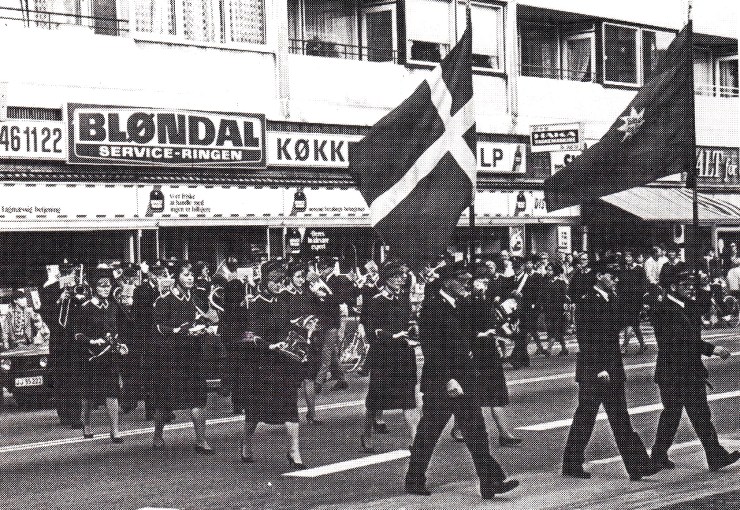
The conditions of people of district developed as the welfare state opened up new possibilities for the working class. They got more and higher education and a number moved to houses and bigger flats at the outskirts of Copenhagen. As the Army soldiers were working class people as well, they followed the same pattern, but they still had their loyalty to Gartnergade corps and came into the district several times a week. This development was at its highest during the 1970s. Not everybody moved out, but the district altered a lot. Around 1980 the Borough of Copenhagen wanted to demolish a number of the buildings, especially the buildings in the yards in order to give room for green areas. This also concerned the Corps building and the search for new premises started.

The last years in this district became a challenge for the corps, especially on its marches and in the open air ministry, because groups of squatters started illegally to occupy the old, empty buildings in the district. The soldiers got used to be greeted with eggs, tomatoes and in between screws when they marched the streets. The close connection to the district had disintegrated because the population had changed. The corps moved to another district of Copenhagen, Valby, where it since 1983 has done a very fine ministry with a close contact to the people of this district. The corps took the name of the district as Valby corps. Today Nørrebro and the district around Gartnergade is totally different with many immigrants, students and troubled young people. There are gangs of different kinds fighting each other, mostly because of the ’drug market’.
My research ends with the move to Valby in 1983.
The articles
The first article published in November has the relationship with the district as a focus through different events. There is also a presentation of the soldiers of the corps and their occupation which appeared to be mostly as skilled workers and artisants. They lived in the district and belonged to it as neighbours and workmates. An analysis of their addresses in the district shows how close to the corps they lived. The corps itself and its meetings and activities both in the open air as well as in the hall was integrated into the district. People did not feel estranged when they entered the Army hall either for participation in some of the fairs, ordinary meetings or the Home League, neither did their children. The corps developed a large Sunday school and YP corps and it was alert to the situation of the children in the district.
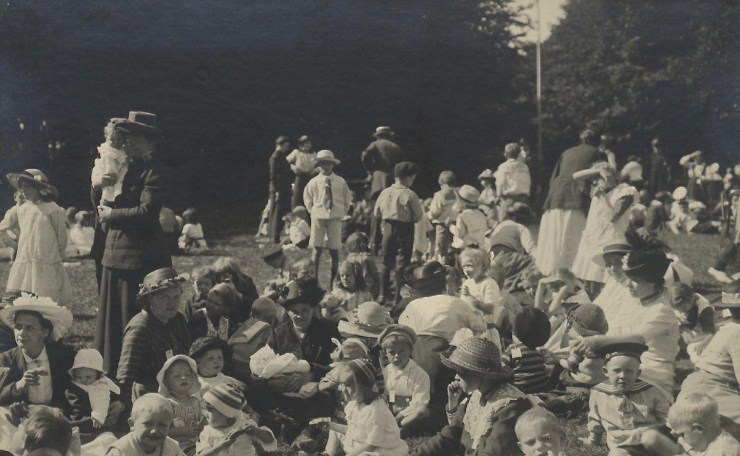
An interesting example of this was an outing for 1000 preschool children (3-7 years) 5th August 1924. Preschool children were very much left to themselves without many activities or much fun at that time. The soldiers started raising funds for this by an extensive open air activity with songs and music different places in Copenhagen where they told about the plans. They went to places where a number of more wealthy people gathered, even to the beaches. They also contacted the businesses and shops in the area as well as the authorities running the tramps and trains. They wanted to get the travel for free. They suceeded in this as well as raising funds. Then the soldiers visited all the homes in the district with smaller children and invited the kids for this daytrip to the beach. The parents agreed to sent their children, for some on the condition that an older brother or sister should join the little ones. The number became higher thatn 1000 when also including the helpers. The corps organized the outing in details by having 10 people in charge, each of these had 10 helpers, and each of the helpers had responsibility for 10 children. The children got a number and the helper got a number so it was possible to locate which 10 children he/she was responsible for. Everybody, parents and children gathered in the street of Gartnergade at 8 am in the morning. The kids marched in lines to the empty tramps which had been arranged for the event. At the end stop of the tramp, the children had to cross a busy road to get over to the train. Again the children walked over there in lines with their leaders. The traffic stopped and people were curious to know what was happening. The same procedure came when the train stopped at the area with the beaches. The day was spend at the grounds of a beach restaurant. The children had to bring a cup and a spoon with them. During the day they had a Danish sort of rice pudding ( a dinner dish, not a dessert) together with this they got a drink of fruit syrup and water. During the afternoon they had a cup of cocoa and Danish pasteries. They were playing in the sand, the water and the grounds around the resturant. The return travel happened in good order like the travel to the beach with a warm welcome in Gartnergade by parents or siblings. No accidents had happened, so the soldiers gave thanks to God for his provision. There is a comment in the history book that it is easier to imagine than to describe the looks of the children on the return travel. Little ones who had been playing all day in the sand, water and grass and had been eating and drinking all the good stuff during the day. All this was quite visible in the faces and clothes of the kids.
The second article which is published at the same time at this overview and called ’The church of the yards and the streets’ and has a focus on the corps in the public square – marches, open air meetings, and the numereous meetings in the smaller yards behind and between the houses. Regular visits to the pubs, devotions at the factories, Commando Raids with a presence at the cinemas late night.

A main focus is the Sunday school which was preceded by meetings in the yards and a march down the street to the corps with a number of children following. Many children from the district participated. The oldest registers of the children in the Sunday school, i have been able to find, are from the 1960s, but they still show a good number of children and also that the childrens’ addresses are in the nearby streets. There were at this time between 140 and 160 children in the register with an average presence each Sunday of 50 to 70. The preschool children always gathered round a sand tray where the stories were unfolded. This class alone had 60 children in the register with an avarage of 30 each Sunday. The leader of this class, Jenny Schrøder, was an eminent story teller (like her mother, Agnes Schrøder who had written the corps history books). She started with this class when she was 14 years of age and continued for 70 years, including a period after the corps had moved to another district in the 1980s. The youth workers held a close contact to the parents by visiting the homes, if the child had been absent or at birthdays. These visits also included special cards, a card expressing that the child had been missed and birthday cards sponsored by the soldiers in the corps.

Erik Silfverberg
The article describes the YP work and the outreach to the district and the homes in connection with this as for instance inviting the parents to the corps for Sunday afternoon coffe on Mothers’ Day and for Christmas parties as well as a possibility for the parents to participate in the Sunday School outing during the summer. Other examples are Friday evenings with programs for the public, where the children were engaged in different small plays and singing. The band and songsters also participated. These evenings changed character during the German occupation where they turned into community which included singing Danish national hymns and folk songs as well as films about Denmark (nature and history).
The corps has quite a fine collection of photoes which can be seen throughout the articles illustrating the corps’ different activities.
There will be published a number of articles more about Gartnergade corps on the Danish side in the coming months, and there will be abstracts in English of these as well. The coming articles will for instance concern the life within the corps, the celebrations and special effords in raising funds, the band and songsters, the comradeship. Another one will have focus on worship life as the old corps history books refers rather detailed programs of the meetings both Sunday meetings and soldiers’ meetings. This will also include the meaning of the symbols and the ceremonies within the corps. I have had an opportunity of gathering 12 different soldiers from the corps, now in their eighties and nineties in smaller gatherings of 4 where they told about the corps life. Apart from these concerning corps life there will be an article with focus on the youth club based on the detailed journal from the 1940s. As this journal covers the time of the German occupation it will include the special challenges of the corps during this time.
 Salvationist viewpoints
MEMORIES
LikeLike