(A paper delivered at a Salvation Army Symposium on “Theology and Etichs” in South Africa 2006. Please consult numbered notes at the end of paper when mentioned. Comments are welcomed)
During December I read an article in our daily newspaper that gave me some inspiration for this theme and for the Army life in general. The article told about the old, famous, Danish porcelain factory, Royal Copenhagen and how it faced the challenge of the eighties and nineties. The market for china changed, not so many young people bought expensive china for dinner sets or tea sets, neither did they bye many fine china figures or decorative plates. This change in fashion had an effect on all the old European porcelain factories. The response to the crisis was different from factory to factory, some amalgamated with fashion houses or perfume brands, and others had to close down. Royal Copenhagen decided to stay who they were, not to water down the profile of the company, so they in reality would become something else. Their philosophy was as follows: ‘We need to keep hold of our tradition in order to succeed. We need to develop but in harmony with our own values.’ The breakthrough for Royal Copenhagen came in year 2000 when a young designer caught the idea of enlarging
a detail of perhaps the most famous pattern ever dating back from 1775, a little straw and a little flower were enlarged so it filled the whole cup or plate. It kept its blue colour and the plate its white colour. It became a major success and reached the marked of the young ones as well as the more settled. Same china, same colour, same pattern, but instead of many small flowers, just one being enlarged. The seize of the cup changed, that was enlarged as well.
In our history, in our worship tradition we have durable and excellent design, beautiful colours and patterns, but they might not look trendy and they might appear to be out of fashion, they might even have been watered down by being amalgamated with something else.
The basic design of the Army life in its totality is the military metaphor. It is being challenged for being out of fashion and not ‘selling’ very well[1], and therefore I look to Royal Copenhagen for inspiration as they faced a similar challenge. I will work visually with our symbols and ceremonies in worship that are reflecting the military metaphor, I will try take out a detail of the pattern and enlarge it to see what happens.
A visual trip
Coming into an Army hall for worship there are many details of a total pattern in the simplest hall as well as the most exquisite temple, but there is one single feature that immediately expresses the military metaphor – that is people in uniform, symbolising that here are not private people but people in somebody else’s service.[2] Some participating by singing, playing, speaking, praying, others on the more passive end of the scale, but at least joining in the singing or the clapping of hands, otherwise listening and participating in prayer.
In the hall there will most probably be somebody in civic as well, and a natural question could be: Why this difference? How do you get from one status to another – from civic to uniform? I will return to that question.
Another feature that signals the military metaphor profoundly is the flag – and I will return to that later in the paper.
Being with people who embody an Army by their uniforms many questions could emerge during the service. Is this service a training ground for the soldiers before being sent into battle or is the ‘war’ going on during the service or is it a field hospital where the maimed and broken soldiers are healed and restored? Listening to songs, music, testimonies, prayers, Bible readings a confirming answer might be given to all three questions, depending on the service. Coming back to the three corps in Bergen it was visible that there was a ‘chief commander’, God, and he was praised in music, songs, prayers and adoration. If the three questions should be answered from this particular Sunday, it would be a yes to all. The mercy seat gave the answer, here people kneeled in prayer at a traditional Army alter, at a simple bench normally used in the cloakroom of the school and at a beautiful altering of a Methodist chapel. Some came for healing and restoration; others were fighting a real battle and some were in silent prayer to be equipped for service.
The enlarged ‘flower’
The mercy seat is the ‘flower’ that needs to be enlarged, the symbol of our worship life that should be altered from a small, sometimes forgotten detail to a major feature. The rationale for that is as follows. The mercy seat can be a real battle ground where victories can be won over sin and evil, over selfishness and indifference. The battle can be about obeying a calling – a calling for becoming a Christian, for starting and continuing a life of discipleship, a calling for soldiership, officership, specific service etc. It is a battle ground to fight whatever resists receiving salvation and sanctification. In Zambia leading a youth congress my husband and I saw a real battle of deliverance from evil spirits taking place. We saw the young Salvationists gather round the man, all fighting through prayer, and we saw the amazing transformation taking place after a long ‘fight’. Coming from the north of Europe this was quite a unique experience, as we never see that sort of battles there, but it visualised this role of the mercy seat.
The mercy seat is a place of transition from one status to another, from disbeliever to believer, from passive to active. It is not only a battle ground; it is a place of healing and restoration as well. It is the ‘field hospital’ for wounded and maimed soldiers.
The mercy seat might contain an element of training and equipping for service, so it can embody all three features. But there is a fourth one as well. The mercy seat is not only a battle ground or a ‘field hospital’ or a training barrack – it is a feeding place. Here people can feed on Christ, the one, true, original sacrament of our life as Christians. As the mercy seat is in common use in the Scandinavian countries it is not only used by the individual, but as an corporate act where all the soldiers in a soldiers’ meeting or all the officers in an officers’ meeting are called to gather at the mercy seat or around it as a corporate act of dedication or a corporate act of receiving what Christ has in store for them.[3]
The one weapon uniting all the different uses of the mercy seat is prayer. The simple prayer connecting to God, the prayer of remorse, the prayer for forgiveness, the prayer fighting to overcome evil, the prayer of thankfulness, of surrender, of adoration. The healing prayer of silence. The prayer of hunger for the living bread and water. I will return to the ‘weapon’ of prayer at the end of the paper.
The symbol of transition – the Soldier’s enrolment = Believers Baptism
Attending a soldier’s enrolment is visually a very strong symbol of transition from one status to another. From the status of a private person just representing yourself to a person representing somebody else and being in the service of somebody. The clothes have been changed from private clothes to a uniform symbolising the new life in Christ’s service, the uniform as a testimony of the death to the old life and the resurrection to the new life in Christ. There is a confession of faith, a placing of oneself at God’s disposal, a dedication of the person to a life of discipleship. It is a confirmation of ethical norms for the following life as a soldier of Christ.[4]
It is profoundly a believer’s baptism, a visible, ritual manifestation of the new life in Christ, a confirmation and confession of faith in Christ, his life, death and resurrection, a Christological initiation. It is an outward act symbolising an inner reality. As a baptism it symbolises the wholeness of repentance, faith, salvation and an experience of the Holy Spirit, a united process that might differ in time, but nonetheless is symbolised here. The experience of the Holy Spirit is connected to baptism, not as a direct outcome of baptism but as a promise in connection with it. In this sense the soldier’s enrolment correspond to baptism.
The uniform is the new baptismal robe. I think we can recognize the soldier’s enrolment as: ”The profoundest significance of baptism is expressed in St Paul’s interpretation of it in the Letter to the Romans as entrance into Christ’s death and resurrection. Baptism’s proper result and counterpart in the continuing existence of the believer is, according to St Paul, death to sin and the living of a life of righteousness unto God (6.1-23).”[5] And “Baptism as the sacrament of death and resurrection thus symbolizes the radical reorientation and transformation which humanity needs, which only God can bring about and which humanity must then make its own”.[6] The soldier’s enrolment symbolises by the uniform an entry into a new set of relationships. A family relationship to the brothers and sisters in Christ. These brothers and sisters are fellow soldiers and visually express the family relationship by wearing the same uniform. The uniform is a sign of this radical reorientation that baptism according to Wainwright means.[7]
The argument against seeing the soldier’s enrolment as a baptism could be that there is no water present, and that might be true. But in this day and age where due to technology we can have all sorts of food in a concentrated form where the liquid has been dried out still being the true stuff, it is even easier to find where the symbol of the water is present, or where the ‘dried’ water is. My suggestion is, that the flag is the baptismal water, it symbolises the cleansing blood of Christ, the fire of the Holy Spirit and the purity of God. It represents the triune God in whose image we were created and to whose image we are restored. This flag or this baptismal water touching our head or resting at our shoulder or folding behind us baptises us as much to new life in Christ as any dip of water.
In this beautiful prayer from the Byzantine rite the word water could easily be exchanged for flag in most places.[8]
I am not suggesting that we incorporate this prayer into our soldier’s covenant, but just making the parallel to our ceremony and the mighty work of Christ which it confirms.
Our Salvation Army ‘national anthem’ O, Boundless Salvation is a mighty baptismal hymn that often when being sung gives a nearly physical sense of the cleansing water without any water being present except in our imagination.
Our weapons
Staying in the military metaphor the weapons need to be identified, the ‘weapons’ used for battle as well as for training and equipping, and for healing and restoration. The strong image of a weapon during our worship is prayer as mentioned earlier. There is another weapon that used to be very visible and that is the Bible. In old Army halls Bible quotations were written on the wall or at the mercy seat. Returning to Bergen 1 there was a very appropriate one written on the front of the balcony facing the soldiers on the platform stating: You are my witnesses! Not many halls have these decorations any longer, but they can be and are sometimes revitalised by using power points, overhead or thin film put on the wall just for that worship to underline the message or theme of the meeting. Their function is not only to equip the soldiers for ‘battle’, but to send a message to those attending worship. The visible Bible quotations stress our first doctrine, that we are rooted in the Bible.
Another way this weapon is visible is by our people bringing a Bible with them to worship. Some do and often there are Bibles next to the songbooks for people to use during service, all this signals the importance of the Bible.
The strong weapon of prayer is visible several times during worship, even though it takes on different forms, not all forms appear as being weapons. The opening prayer of our worship might be a longer setting for prayer of adoration and praise, some uniting all in singing praise choruses with spontaneous prayers in between, or a more formal prayer after a Bible reading. Then there will normally be a prayer of thanksgiving after collection, perhaps a prayer before the sermon, and most certainly prayer at the end of the meeting. It is at the end of a meeting when time is given that the real weapon of prayer is made visible by the prayers at the mercy seat or prayers coming from people in the hall or in the silence of prayer.
I have an appendix of this paper.[9] It is a little unusual appendix made for each of you in order to focus on prayer as our most important weapon and in order to bring the symbols out of the hall into everyday life. It is a little folder and a string of wooden pearls with prayer attached to each pearl (or it might be more appropriate to call them wooden bullets. They might represent the bullets from the Chrest). The Catholics have a rosary where they will call on all the saints, it is not anything like this. It is meant to be a tangible support for prayer and meditation, a constant reminder of the basic belief of Salvationists. As you feel the touch of the pearls (or bullets) you concentrate your prayers round these basics. The blue pearl represents the spring of purity and holiness – God our Father. This is followed by four small pearls of reflection meditating God being perfect in holiness, perfect in wisdom, perfect in power, perfect in love. Then comes the red pearl representing Jesus Christ, God’s eternal Son our saviour, followed by four pearls of reflection meditating repentance, grace, faith and assurance. The yellow pearl represents The Holy Spirit, Lord and Giver of life followed by four pearls of reflection meditating God’s gracious provision, the sanctifying Spirit at work, a radical life-change and the fruit of the Spirit. The last pearl is totally different in shape, material and colour. It is a pearl of intercession – the pearl for others, for the world.
Conclusion
When worship is at its best all our senses are being made active. I have concentrated most of the paper on the visual side of some of our symbols and ceremonies concentrated on the mercy seat as the ‘enlarged flower’, it is just in the appendix that the sense of touching comes into the picture. The rich symbol of music, sound and silence I have had to bypass due to the limits of the paper. I would have liked to include more of the significance of the senses as e.g. simple acts of breaking bread together as a love feast during a harvest festival or just before Easter or the use of water as an act of cleansing or as a symbolic act of drinking the living water or the frequent use of candles in smaller prayer gatherings in the cold North, but the limits of the paper do not allow for that.
As I see it the military metaphor is a frame where all sorts of worship can be expressed and can thrive from the very ‘churchy’ style that is nearly ritual in its setting to the very free with dancing, singing, shouting, clapping etc. There is though a negative side of the metaphor as well, even though I do not think that applies so much to our worship as to the possible affect on personalities. The metaphor especially the uniform wearing signals that we are in somebody else’s service. There is a danger of a split in being in service and being out of service, being a private person opposed to a uniformed person showing itself in a difference in the uniformed lifestyle to the civilian lifestyle. A danger that has been recognised up through our history and one that has to be addressed for every generation. An argument against the uniform wearing has been that is makes a distance to other people and I think that is true. This distance has however proven to be helpful for people in need that they feel more free, because they do not get too close to an individual person, but in a way to what they represent.
As Salvationists we arrange worship whenever possible and whenever practical, even though we love to follow the example of the early Christians who choose the day of resurrection for the great celebration of the week. Living in Russia was a constant reminder of that as the name for Sunday in Russian is voskresenia – resurrection. In worship we celebrate the gifts of salvation and holiness and by doing so our identity is built upon these gifts. If we discontinue our celebration as this unique Salvationist community of faith with all its rich heritage, with all its special colours and flavour, we impoverish ourselves. Part of our social memory concerning our tradition might be lost in a social amnesia. This loss will be a threat to our identity and our sense of community. We need to be inspired by Royal Copenhagen and enlarge a detail of our design, instead of setting it aside.
[1] At least that has been the situation for some years. I think 11 September has changed the relevance of a military metaphor. Whatever opinions we individually might have on the ’war on terror’ – the military metaphor is on the agenda again having an impact on people.
[2] In March we visited the three Army corps in Bergen the same Sunday. Bergen I in the morning was a traditional Army hall with most of the congregation very well uniformed soldiers, Solheimsviken in the afternoon was a classroom in a run down school with a minority of the congregation in uniform and in the evening Ladegården corps had a service in a Methodist chapel due to rebuilding of the hall, but mostly filled with uniformed soldiers. In spite of the enormous difference in the congregation, in the halls and in the worship style it was very obvious genuine Army expressions of worship, as the strong symbols of the military metaphor, the uniform, the mercy seat and the flag were present.
[3] Due to the strong tradition of confirmation in the Scandinavian countries the Army has a ceremony of confirmation for young people at the age of 14 to 15. It comes after a year long preparation and training in the Christian faith. During the ceremony the youngsters will kneel at the mercy seat after having confirmed their Christian faith for the prayer of blessing.
[4] The soldier’s enrolment. After reciting the doctrines
And making the statement that soldiers are required to sign the soldier’s covenant: In doing so they testify that: they worship God as Father, Son and Holy Spirit. They have accepted Jesus Christ as Saviour and Lord. They desire to fulfil their membership of his Church on earth as a soldier of The Salvation Army. They affirm their belief in the Bible as the word of God, and their acceptance of The Salvation Army’s articles of faith. They declare that. They will be responsive to the Holy Spirit and seek to grow in grace. They will make the values of the Kingdom of God the standard for their lives, showing Christian integrity in their deeds, maintaining Christian ideals in their relationships, and upholding the sanctity of marriage and family life ,they will be faithful stewards of all they have and are, they will abstain from the use of all enslaving substances and harmful adtivities, they will be active in God’s work both in sharing the gospel and in serving the needy, and will contribute financially to its support. They will be true to the principles of The Salvation Army. They witness that they freely enter into this covenant, convinced that the love of Christ requires the devotion of their lives to his service for the salvation of the whole world. And they declare their determination, by God’s help, to be true soldiers of the Salvation Army.
The question asked is. Do you declare, in the presence of God and this congregation, that you undertake, by the help of the Holy Spirit, to live and work as a true soldier of Jesus Christ and of the Salvation Army, according to the witness and promises you make this day. If so, raise you right hand and say, yes.
[5] Geoffrey Wainwright: Doxology p. 73 , Epworth Press, London 1982
[6] Doxology p. 74
[7] Apart from Wainwright, who is a Methodist, I have in my preparation made use of ‘Dåben i Ny testamente’ (Baptism in the New Testament) edited by Sigfred Pedersen, Aros 1982, Århus Universitet. The book contains many different views on baptism especially from Lutheran scholars.
[8] “..Thou didst sanctify the waves of Jordan, thou didst send down thy Holy Spirit from heaven and crush the heads of the serpents that lurked there. Therefore do thou, our loving king, be present now in the visitation of thy Holy Spirit and sanctify this water …May all the enemy powers be crushed down by the sign of the type of the cross of thy Christ. May all aerial and unseen shapes depart from us, may no dark demon lie hidden in this water: and we pray thee, Lord, let no evil spirit go down with him at his baptism to bring darkness of counsel and confusion of mind. But do thou, maker of all things, declare this water to be a water of rest, water of redemption, water of sanctification, a cleansing of the pollution of the body and soul, a loosening of chains, forgiveness of sins, enlightenment of souls, washing of rebirth, grace of adoption, raiment of immortality, renewal of spirit, fount of life. For thou, Lord, hast said, Wash you and make you clean (Isa.1:16). Take away the wickedness from our souls. Thou hast given us the new birth from above by water and spirit. Be present, Lord, in this water and grant that hose who are baptized therein may be refashioned, so that they may put off the old man, which is corrupt according to deceitful lusts ( Eph.4.22), and put on the new man, which is restored after the image of him that created him (Col. 3.10): that being planted together in the likeness of the death (Rom. 6.5) of the Only-Begotten Son, through baptism, they may share also in his resurrection: and guarding the gift of thy Holy Spirit, and increasing the store of grace, they may receive the prize of the high calling (Phil. 3:14) and be numbered among the first-born who are written in heaven (Heb. 12:23) in Christ Jesus our Lord”. Doxology p. 104
[9] The reason for trying to make a prayer string has been the wide spread use in the Schandinavian countries of a prayer string made by a Swedish Lutheran Bishop, Martin Lønnebo. It shows the profound need for something tangible as a support for concentration in prayer. Another reason was the ‘insight’ a certain radio interview gave me. A successful Danish actress in her mid thirties revealed a bit of her otherwise hidden faith in the program. She talked for her need of prayer, already as a child. Growing up in a very ‘liberal’ family without faith she knew she could not share her desire with her parents. She found her own way of communicating with God. Later in life she needed more than the prayer of a child and started searching in bookshops for material and found a fountain of richness in the old Church Fathers. She never contacted the church or a minister. This was apparently the first time she shared her ‘hidden’ prayer life. I realised that the art of prayer do communicate with secular people of today as well as with our own people, and that all means to support this art had to be developed.
A Salvation Army Prayer String
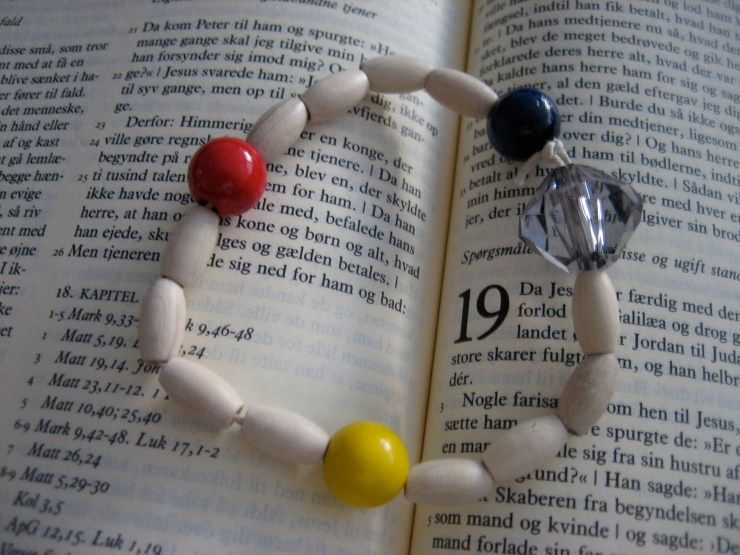
by Gudrun Lydholm
This prayer string of pearls is meant to be a tangible support for prayer and meditation, a constant reminder of the basic belief of Salvationists. As you feel the touch of the pearls you concentrate your prayers round these basics.
The blue pearl – The spring of purity and holiness – God our Father
“You are worthy, our Lord and God, to receive glory and honour and power, for you created all things, and by your will they were created and have their being.” Revelation 4.11
“A feeling of awe in the presence of God is common to religious experience. We reach out to that which is different from ourselves, to complete purity and goodness, not simply to greater power. What we are recognising is the holiness of God. Our sense of awe is often accompanied by an awareness of guilt and unworthiness in the presence of divine holiness.” Salvation Story p. 30
“We are called to reflect the holiness of God. God is holy, awesome in his majesty and in the beauty of his character. He is all that true love could desire. His children are called to a related holiness, dedicated to the service of the holy God and called to be like him in character.” Salvation Story p. 87 -88
Create in me a pure heart, O God, and renew a steadfast spirit within me. Do not cast me from your presence or take your Holy Spirit from me. Restore to me the joy of your salvation and grant me a willing spirit to sustain me. Psalm 51. 10-12
The four pearls of meditation and reflection
- Perfect in holiness – Meditate on the words from Revelation 4.8:“Holy, holy, holy is the Lord God Almighty, who was, and is, and is to come.”
Reveal yourself to me, God, in your holiness and majesty!
- Perfect in wisdom – In silence let the words from Romans 11.33 be rooted in you: “O, the depth of the riches of the wisdom and knowledge of God! How unsearchable his judgments, and his paths beyond tracing out!”
God, let me grow in wisdom that comes from you!
- Perfect in power – Meditate on the words from Isaiah 40. 25-26, 29: “To whom will you compare me? Or who is my equal? says the Holy One. Lift your eyes and look to the heavens; who created all these? He who brings out the starry host one by one, and calls them, each by name. Because of this great power and mighty strength not one of them is missing…..He gives strength to the weary and increases the power of the weak.”
God, be my strength!
- Perfect in love – Receive the words from 1 John 4.16 and Romans 5.8: “And so we know and rely on the love God has for us. God is love. Whoever lives in love lives in God, and God in him.” “But God demonstrates his own love for us in this: While we were still sinners, Christ died for us.”
Thank you, God, for your love for me!
Red pearl – Jesus Christ, God’s eternal Son our Saviour
“Praise be to God and Father of our Lord Jesus Christ! In his great mercy he has given us new birth into a living hope through the resurrection of Jesus Christ from the dead, and into an inheritance that can never perish, spoil or fade – kept in heaven for you.” 1 Peter 1. 3-4
“The loving obedience of Jesus was the means through which God reconciled the world to himself. We are part of that world. Salvation is to enter by faith into the story of Jesus, so that, associated with and transformed by his death and risen life, we may share the fruits of his self-giving.
Because Jesus is our Saviour, the story of Jesus is our salvation story.” Salvation Story p. 42
May your grace transform me day by day, that the wonder of salvation may stay fresh and real for me. May my life reflect your presence and your resurrection power.
The four pearls of meditation and reflection
- Repentance – Bring before God all that creates a distance between yourself and him, bring all that needs to be forgiven. Be still in his presence, just pray: Our Lord Jesus Christ, have mercy on me!
- Grace – Receive and accept the words from 2 Corinthians 12. 9 as spoken to you: “My grace is sufficient for you, for my power is made perfect in weakness.”
- Faith – While trusting him, surrender yourself to him and submit your whole being into his hands – he who was, who is and who is to come. In silence make room for a growing faith in him. Christ, come be with me and walk the road of my life ahead of me, next to me, that I in faith can live in your grace and peace!
- Assurance – Rest in the knowledge that you are precious, loved and accepted.
Yellow pearl – The Holy Spirit, Lord and Giver of life
“To the Christian, the Holy Spirit is both a tender, intimate presence and a mystery beyond full understanding. He brings God near to us and directs our attention to Jesus.” Salvation Story p.50
“The Holy Spirit is always contemporary. He is God acting for us today, giving us confidence in the Christian mission and enabling us to look forward with hope to the ultimate fulfilment of God’s purposes………Within the flow of salvation story, the Holy Spirit, giver of life, guides and vitalizes our mission to live the story, to tell the story and to help others to make it their own. “Salvation Story p.55
Send your Holy Spirit over me and fill me with his fire and power. Make my life and service a living and trustworthy testimony to you.
The four pearls of meditation and reflection
- God’s gracious provision – “Peace be with you! As the Father has sent me, I am sending you” And with that he breathed on them and said, “Receive the Holy Spirit.” John 20. 21-22. Holy Spirit, come rest on me!
- The sanctifying Spirit at work – Meditate on the words from Romans 8.26: “In the same way, the Spirit helps us in our weakness. We do not know what we ought to pray for, but the Spirit himself intercedes for us with groans that words cannot express.” Holy Spirit, help me to trust your work!
- A radical life-change – Meditate what the words from Galatians 5.25 mean for your life: “Since we live by the Spirit, let us keep in step with the Spirit.” Holy Spirit, come alive in me!
- The fruit of the Spirit – “But the fruit of the Spirit is love, joy, peace, patience, kindness, goodness, faithfulness, gentleness and self-control.” Galatians 5. 22-23. Holy Spirit, may your fruits be seen in my life. Lord and giver of life equip me for your service!
The pearl of intercession – ‘Others’ – the World
“For God so loved the world that he gave his one and only Son, that whoever believes in him shall not perish but have eternal life.” John 3.16
While interceding for others, those close to you, those you hardly know, those placed on your heart to pray for, keep in mind the love of God to all.
When William Booth was asked to describe Salvationism in one word, his word was: Others!
Conclude this time of prayer and reflection by holding the whole string of pearls in your hand as a sign of surrender to God, resting in Him who is, who knows and who has all power. Take all the time you need for this!
(The inspiration to make a Salvationist prayer string comes from seeing the widespread use of ‘the Christ prayer string’ made by the Swedish Lutheran bishop Martin Lönnebo in the Scandinavian countries.)
 Salvationist viewpoints
I was entergised reading this article. It speaks of the deeper understandings of the richness of the SA. The prayer beads may be a help to some. Not a necessity but a help. Thank you
Harry
LikeLike
…….kommentar på Norsk. Indsender kendt for redaktionen. Meget interessant og godt stoff til ettertanke for Salvasjonister. Dessverre tror jeg ut fra observasjoner at mange ikke er rotfestet i vår troslære, de mangler kunnskap om den, og mange mener den har mangler, f.eks. når det gjelder sakramenter og på det moralsk/etiske området. De kjenner ikke dybdene i vår symbolikk. Som følge av dette ser vi korps i dag som har navnet Frelsesarmeen, men et menighetsliv og en praksis langt fra vår lære og tro. De mener, som du Gudrun skriver, at vi er utdatert og alt må derfor forandres, det vil si glemmes, og nye ting må inn. Jeg er redd for utviklingen av det som lett kan bli en overfladisk tro med fokus på glede, lovsang, ‘Jesus er konge’ og at våre samlinger må være gøy. Takk for fokus på skatter i vår tradisjon og vårt kall som Frelsesarmeen.
LikeLike
COMMENT FROM AUSTRALIA:
This article by Gudrun Lydholm did my heart good. I am concern about the direction the Army is taking here in Australia with many of our distinguishing characteristics disappearing. In many corps there is the Mercy Seat has been removed and if there is a Mercy seat, an appeal is often not made. The Army Flag has also been removed from some of our Halls and a Red Shield has replaced the Army Crest. I recognise that we need to change to meet the needs of a changing world, but there are some basic distinctive features that point to our theology behind what we do. My question is, “if we the “doing away” with our distinctive features would help our ministry, why aren’t we growing? Gudrun’s paper draws us maybe helps clarify why we are not growing.”
LikeLike