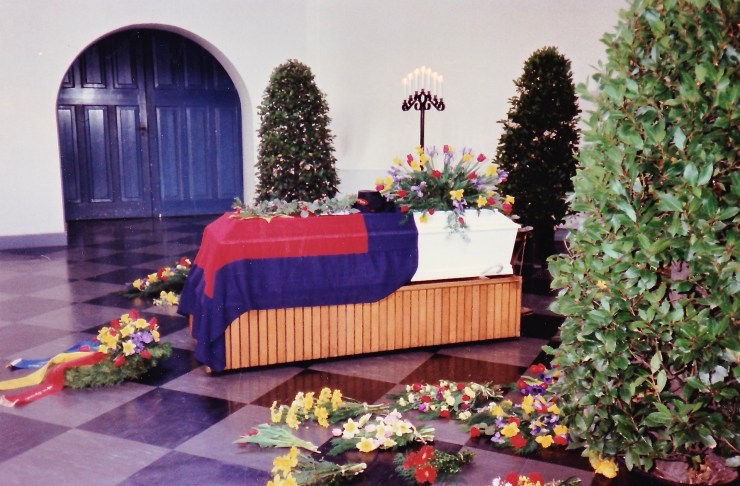
Gudrun Lydholm
A year ago I was asked if I would research and write on the theme Promoted to Glory for Frelsesarmeen’s (The Salvation Army, Norway) historic magazine which for this issue would look into traditions around death in The Salvation Army.
Because of this request my thoughts started being on questions like these: What do we believe concerning death and life eternal? How do we express our faith about the transition from life to death through our language, and even more important from death to new life with God. Which figures of speech are generally used both officially and more privately? What do these figures of speech tell about us and our faith? I will try to address these questions.
One thing is what our doctrines and the funeral ceremony say, and which we adhere to through our soldiership, and when we participate in funerals or are in charge of them. Another thing is, how we express ourselves through our songs in meetings and worship. It is quite interesting to study how much songs about life to come or everlasting life are in use today. In my research which was done and written in Danish[1] I looked into Danish songbooks from 1898, 1907, 1921, 1948, 1969, and the latest 2000. There is a great difference on the number of songs about Eternity in the songbooks and on the use of these songs. From my perspective these songs are not used as frequently today as they used to be, but I am sure it differs from corps to corps and country to country.
In my research of the Danish songbooks I also looked through a songbook for children and youth from 1898, which puzzled me at first. More than a third of the songs concerned death, heaven and eternity. When I pondered on why this great focus on death and heaven was there, I realized the great difference from today in life’s challenges. Infant mortality was high and the same was the number of women dying in childbed. Children experienced smaller siblings dying or loosing their mother in childbed. They were more vulnerable to different infections, because the medicine available at that time was not as advanced as today.
The great gamechanger was the introduction of penicillin which cured a lot of infections and illnesses that previously were dangerous as for instance pneumonia. Because of these life circumstances and personal experiences songs about heaven were relevant for the faith and hope of children and youth. They were also a comfort in their grief.
A song of Horatius Bonar[2] illustrates the situation. The song is Where the faded flower shall freshen, especially the last part of verse 3:
Where the child has found the mother,
Where the mother finds the child,
Where the loved ones all are gathered
That were scattered on the wild.
With the refrain:
We shall meet and we shall rest
‘Mid the holy and the blest;
We shall meet on yonder shore,
With the loved ones gone before;
We shall meet and we shall rest
‘Mid the holy and the blest.
Each of the songbooks reflect the time, they represent by the songs they have and by the popularity different songs have. Death is not as close to our everyday life as it used to be. The number of the younger generation who have experienced death at close hand is smaller today and many have never seen a dead person. The tradition with the coffin standing open in the home and a ceremony of ‘singing the deceased out’ of the home has gone long ago. As young corps officers we did experience this a couple of times, even though this tradition was fading away. Today there is a greater distance to death as it is hidden away in hospitals and care homes. Because of that the songs about death, heaven and eternity might not be felt as relevant. Focus is on life here and now and our songs reflect this. At least that was my impression, but a concert by a gospel/praise group of young people from two Copenhagen corps moderated this attitude. They started the concert with instruments and singing for full power:
When we all get to heaven,
What a day of rejoicing that will be!
When we all see Jesus,
We will sing and shout the victory.
I think the whole congregation enjoyed this old well know song by Eliza E. Hewitt[3]. The young people not only gave their voices full power, but it seemed as if their souls were in it as well. Another corps youth choir was singing Heaven is a wonderful place, filled with joy and peace. There we shall live in eternity. Heaven is a wonderful place.(The song is in Danish, so this was just a translation of the meaning). After these two experiences I had to conclude that songs of heaven are still around, also in the young generation.
With age you get more conscious about your own mortality, and because of that the whole question about death and the beyond comes closer and feels more relevant that it perhaps did earlier in life. Nevertheless, young people are using the songs whether they might find them relevant or not in their personal life.
Easter day with all its hymns and songs of resurrection, the strong message of the resurrection of Jesus Christ and the belief in this is very important and central for all generations. It is the great celebration which is the foundation for our Christian hope of resurrection and eternal life. This hope and faith is reflected in how we imagine or visualize heaven and the way we express this in our songs, doctrines and ceremonies.
Promoted to Glory
As Salvationists we are using the expression Promoted to Glory, quite a pronounced expression, which other Christians might be questioning and at least want an explanation for. I am sure each of us try to give an explanation as well as we can in a given situation.
I wanted to find the source of this expression to answer the questions why and when was the expressions introduced. It is easy to find out when, but it turned out to be more difficult to give an answer on the why. There are not really any written sources in the archives as to why this expression was introduced. It has demanded quite a lot of research to find a possible originator to the expression. It suddenly appeared for the first time in the War Cry 14th December 1882, and the second time was 15th January 1883. Since that time it has been used, not as the only figure of speech, but after a while as the dominant expression.

Catherine Booth might have been the creator of the expression, as she cherished it. In his biography of Catherine Booth, Roger Green writes about her funeral: “The funeral – or the promotion to Glory service as Catherine Booth would have it..”[4] The expression was dominant at her funeral, which took place 13th and 14th October 1890. On the 13th her coffin was brought from the family home to Olympia, a great exhibition center in London. At 6 pm the memorial service started. It concluded by an alter call to the Mercy Seat. Hundreds of people accepted the call. The next morning 14th of October the casket was transported from Headquarters to Abbey Cemetery. 5000 officers were allowed to join the long procession walking the six kilometer to the cemetery. 10000 people were invited into the cemetery for the ceremony.
Herbert Booth[5] had promised to write a piece of music for the procession, but had not managed to do this until the night of the 13th. It was played during the procession and the name of it was Promoted to Glory. He later wrote the song to this tune: Summoned Home! The call has sounded.[6]
In the work of reference A to Z of The Salvation Army[7] it says that The War Cry had coined the expression Promoted to Glory. I was not able to find who was the editor in 1882 and wondered which editor would have come up with this new figure of speech. It made me think of Georg Scott Railton who would have the authority to break new ground with this expression. He together with Catherine Booth were the main creators of the military metaphor which it is part of. Railton was close to the Booth family and lived in their home eleven years from 1872/73 to 1884. By searching Bernard Watson’s biography of Georg Scott Railton[8] I discovered that Railton was acting editor in chief in 1881 after having been called back to London from his pioneering in USA. As far as I can gather he was also acting editor in 1882 and possibly until 1884. It is a ‘real’ Railton expression, so I find it convincing or likely that he as editor coined the expression.
Railton was called home to England to lead Catherine Booth’s funeral. Catherine Bramwell Booth writes extensively [9]about the funeral. The words Railton used at the ceremony are nearly the same as is used today: “As it has pleased the Almighty God to promote our dear Mother from her place in The Salvation Army to the Mansion prepared for her above, we now commit her body to this grave…” The word ‘promote’ is used, but not to glory but to the mansion prepared above.
In Krigsråbet – the Danish War Cry the coverage of her death and funeral was extensive. The front page presented a letter from the General concerning her death with a large heading Promoted to Glory with a fine graphic picture of Catherine Booth. It was already publish 18th October four days after the funeral. In the article in the paper concerning her life, death and funeral the expression transferred to Glory was also used. The expression promoted to Glory has been used in the Army in Denmark since the coverage of Catherine Booth’s funeral. The Army in Denmark was at that stage three and half years old.
As the Army attracted a great number of young and younger people in the countries it spread to, there would not be many obituaries in the Army’s papers in the beginning. The first obituary from a Danish corps was published in Krigsråbet 30thMarch 1889 and the expression transferred to Glory was used. It was 18 months after the Army’s beginning in Denmark. Both the word transferred as well as promoted belongs to the military metaphor.
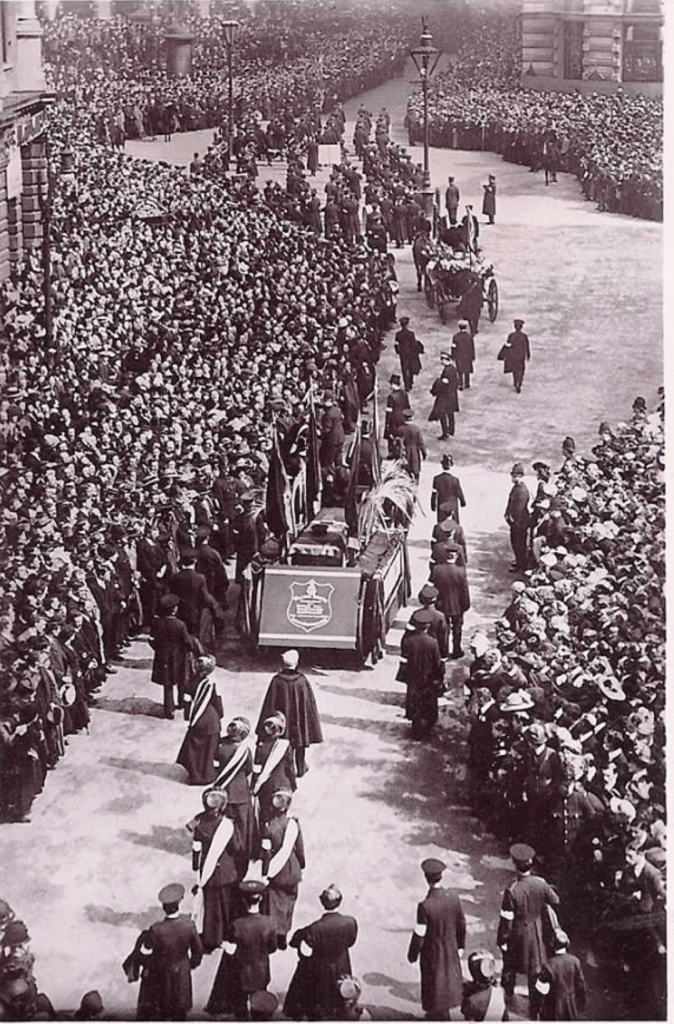
The reports from William Booth’s death and funeral in 1912 used Promoted to Glory as the central expression in headings and descriptions. The hearse that headed the long procession through the streets of London the words laid down his sword were written along all four sides. This honour was only given to him. The band in the procession played the dead march Saul from Händel’s oratorium, but when the procession passed Headquarters Herbert Booth’s Promoted to Glory was played.

Promoted to Glory had become the Army’s expression for death and it stayed as such, and characterized all Army funerals the following years until today. The obituaries in the War Cry in different countries and languages still use the expression even though laid down his/her sword also have been used throughout the years. These descriptions of death belong to the military metaphor. The other description transferred to Glory also belongs there.
When the Christian Mission transformed itself to The Salvation Army in 1878 the whole organization was transformed to reflect a Christian military force. Members became soldiers and ministers officers, who got military ranks reflecting the level of responsibility and years of service. This new metaphor mobilized and inspired the forces of soldiers and officers to a degree that a rapid growth of the Army started, and it shaped our thinking and language not only in describing organizational issues in military terms, but also the life of faith and worship used language that reflected this. Battle, fight and victory became natural vocabulary for Christian experience, naturally also defeat, even though that wasn’t used as much. Into this world of military vocabulary the expression promoted to Glory came into use four years later in 1882
A promotion normally has do with our work and position, where it describes a change in status from one position to another. When it concerns death, it really is a change in status from being alive to being dead. By the grace of God we will be lifted from our earthly life to a life in his presence. Through Jesus Christ we will be reborn to a living hope through his resurrection while we are living here, and through him by the grace of God we die into the presence of God, we walk from death to eternal life – we are promoted to glory.
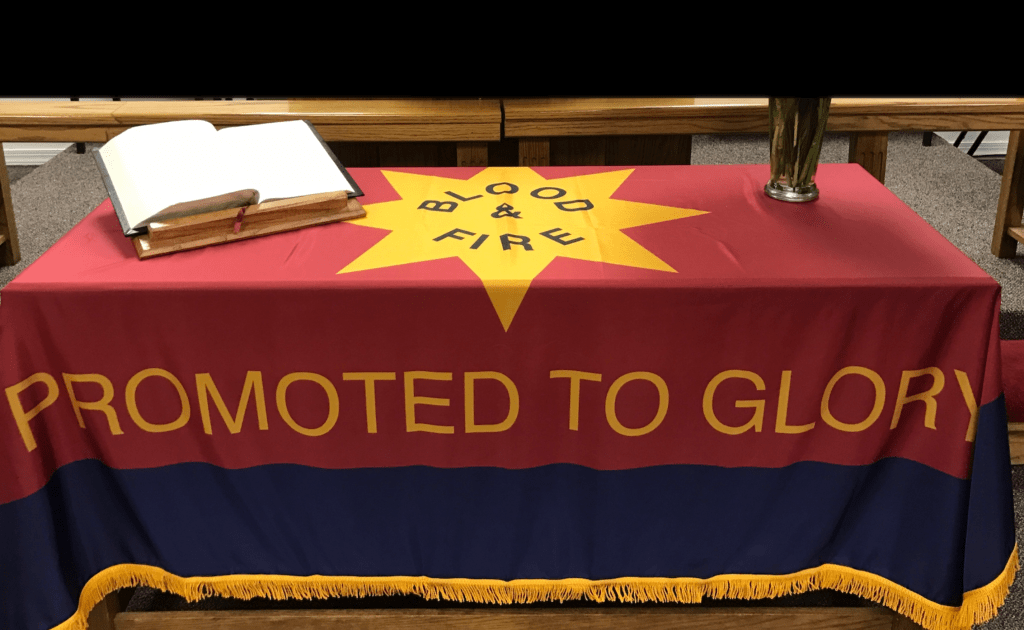
Looking through different Danish War Cry randomly from the beginning and up through the years it was clear that promoted to Glory was not the only expression, also called home or called home to God. They seem to be interchangeable, but it seemed that promoted to Glory was the dominant expression for officers while for soldiers and local officers one of the three expressions were used. There didn’t seem to be a system apart from the years in the 1970s, where obituaries in the same issue would use called home to God for soldiers and local officers and promoted to Glory for officers. This difference in vocabulary was only for some years and must reflect the choice of the editor at that time. The dominant one for both soldiers and officers was and is promoted to Glory.
In the Norwegian War Cry the expression promoted to Glory did not appear before 1911 and was not dominating, especially laid down his/her sword seemed to be used as well.
I have asked a couple of officers from the Eastern Europe Territory which expression they use to describe the death of Salvationists, and both of them answered promoted to Glory. They treasured this expression and felt it very special at the funerals they had been in charge of. One of them had lost her husband to Covid 19. She had felt this expression as very strong and powerful in her situation of loss. It seems that the expression is also relevant in countries where the Army don’t have a long tradition.
The Christian hope of eternity in our songs
There are many different images for ‘the Glory’ we will be promoted to. In my research of Danish Salvation Army songbooks the dominating image is song, the new song of praise, which we one day will participate in, the sound of harps and the music that gush forth. In one the image is that the singing shall be as strong as the sound of a mighty river. This heavenly song is all inclusive, so it makes everything to reverberate, the singing and the music gushing forth, the register of tunes is used fully. Our singing here on earth is only a pale reflection of the song in heaven.
Summoned home by Herbert Booth[10] as mentioned earlier has the welcoming song, eternal peace, rest and mysteries explained:
Summoned home! The call has sounded
Bidding a soldier his warfare cease;
And the song of angels resounding
Welcomes a warrior to eternal peace.
Praise the Lord! From earthly struggles
A comrade has found release.
Death has lost its sting, the grave its victory,
Conflicts and dangers are over;
See him honoured at the throne of glory,
Crowned by the hand of Jehovah.
Strife and sorrows over,
The Lord’s true faithful soldier
Has been called to go from ranks below
To the conquering host above.
Once the sword, but now the sceptre,
Once the fight, now rest and fame;
Broken every earthly fetter,
Now the glory for the cross and shame;
Once the loss of all for Jesus,
But now the eternal gain.
Trials and sorrows here have now their meaning
Found,
Mysteries their explanation;
Safe for ever in the sunlight gleaming
Of his eternal salvation.
The song of ages by Richard Slater[11] shows that the heavenly song is united with the earthly one as the song is the same. The two first verses have this theme. In Denmark we have a Swedish song which underlines this even further, where the text of the chorus asks: ‘Do you ever hear the echo of the heavenly song?’. Unfortunately it is not in English.
The soldiers of the cross on earth as well as those in heaven
One song are ever singing, full of praises,
To Him whose blood on Calvary for them in love was given,
The blood by which was purchased their salvation.
Praise, oh, praise him!
Swell the song that’s rung thro’out the ages;
Praise, oh, praise Him,
The Lamb once slain!
Oh, sing the grand old song again,
How the precious flow
Washes white as snow!
Oh, sing the grand old song again,
Of the fountain that was opened at the cross![12]
The throng that stands before the throne with victors’ palms and crowns,
Have been on earth, for Jesus, valiant soldiers;
Their fight is o’er, death’s stream they’ve crossed,
but still in heaven resounds the song about the blood of their Redeemer.
In the second verse we have the image of death’s stream they’ve crossed. An image of death’s river or stream that occurs in other songs as well. In this metaphor life here on earth is on one side of the river and heaven on the other side – the heavenly shore. The thought of death as a river is also present in Greek mythology with the river Styx among others (there were five rivers), with Hades, the kingdom of death, as the shore. It was a sad shadowland. In the Christian songs the shore is heaven, the dwelling of God, the city of God, where he is and where we shall be with him in eternity. Here is joy, an abundance of songs and grand music with an overwhelming beauty. Everything is full of peace and the presence of God.
There are plenty of images of heaven in our songs, many of them build on the Book of Revelation as for instance the golden city with a pearly gate, streets of gold, the river of life and the eternal light and day. A song like Where the faded flower shall freshen has the brightness and daylight as an image, an everlasting summer:
Where the faded flower shall freshen
Freshen never more to fade;
Where the shaded sky shall brighten,
Brighten nevermore to shade;
Where the morn shall wake in gladness,
And the moon the joy prolong;
Where the daylight dies in fragrance,
‘Mid the burst of holy song.
In some of our songs hope of reunion with family and friends gone before us is a strong theme, a matter of rejoicing and hope. O think of the home over there [13]by DeWitt Clinton Huntington (1830-1912) is an example of a song with this in focus:
O think of the home over there,
By side of the river of light,
Where the saints all immortal and fair
Are robed in their garments of white.
Over there, over there, o think of the home over there
Over there, over there, o think of the home over there.
O think of friends over there,
Who before us the journey have trod;
Of the song that they breathe on the air
In their home in the palace of God.
My Saviour is now over there,
Where my kindred and friends are at rest;
Then away from my sorrow and care
Let me fly to the land of the blessed.
I’ll soon be at home over there,
For the end of my journey I see;
Many dear to my heart over there
Are waiting and watching for me.
In the song Beautiful land, so bright, so fair by R. Moorcock we have several of the themes already mentioned present. We have rivers and strand, not as the river of death, but more the river of life, Revelation 22. 1-2 “the river of the water of life as clear as crystal,”. There are ‘songs triumphant and music grand’, and the meeting between ‘kindred souls’. It is a beautiful land.
Beautiful land, so bright, so fair,
Untold glories linger there,
Crystal rivers and shining strand,
Home of the soldier, beautiful land!
Beautiful home, beautiful home,
Home of the soldier, beautiful, beautiful home.
Beautiful theme, the courts above
Echo with redeeming love,
Songs triumphant and music grand,
Home of the soldier, beautiful land!
Beautiful prospect, converse sweet,
Kindred souls each other greet;
Blest are they children, a holy band,
Home of the soldier, beautiful land!
Beautiful thought, though earth decay,
Stars grow pale and pass away,
Firmly shall thy foundation stand,
Home of the soldier, beautiful land!
The songs mentioned are written in the nineteenth hundred, a more recent song from the twentieth century is John Gowans’[14] song. The theme of this song is on people entering the kingdom of God from the east and the west, from every nation, every race and social class. It is not so much about what the Kingdom of God is like, but the welcome: to be met by their Father and welcomed and blessed (v.2) and then the quality of being there to triumph and rest they’ll sit down in the Kingdom of God. What is central is the criteria for entering the kingdom – the white wedding robe. That will be worn by those, whose names are in God’s book of life:
They shall come from the east, they shall
come from the west,
And sit down in the Kingdom of God;
Both the rich and the poor, the despised, the
Distressed.
They’ll sit down in the Kingdom of God.
And none will ask what they have been
Provided that their robes are clean;
They shall come from the east, they shall
come from the west,
And sit down in the Kingdom of God.
They shall come from the east, they shall
come from the west,
and sit down in the Kingdom of God;
to be met by their Father and welcomed and
blessed,
and sit down in the Kingdom of God.
The black, the white, the dark, the fair,
Your colour will not matter there;
They shall come from the east, they shall
come from the west,
And sit down in the Kingdom of God
They shall come from the east, they shall
Come from the west,
And sit down in the Kingdom of God;
Out of great tribulation to triumph and rest
They’ll sit down in the Kingdom of God.
From every tribe and every race,
All men as brothers shall embrace;
They shall come from the east, they shall
come from the west,
and sit down in the Kingdom of God.
The musical Blood of the Lamb visualized the content of the song. Vachal Lindsay’s poem “General William Booth enters into Heaven” [15]was the inspiration and decided the basis of the musical.
One of William Booth’s favorite songs: Are you washed in the blood[16] is central in the musical. The chorus is :
Are you washed in the blood,
in the soul-cleansing blood of the Lamb?
Are your garments spotless? Are they white
as snow?
Are you washed in the blood of the Lamb
The different people in the Musical wear their white garments because of their experience of being ‘washed in the blood of the Lamb’.
The inspiration to write about heaven with different images seemed to be more popular in the nineteenths century than later in the twentieth century, at least after World War II. Thoughts and speculation about death and eternity or heaven might have been much stronger than today. Death is not so close to our everyday life as it used to be because of medicine that can cure many infections which in previous years were fatal. This means that the greater heritage of songs about heaven comes from that period, while there are very few contemporary songs on this theme. We might find it difficult to visualize heaven or eternity in order for it to give meaning for us today. John Gowans did this in modern time by underlining the universal scope of the Kingdom of God in all nations and among all social classes and the welcoming of all who have been ‘washed in the Blood of the Lamb’. He does not visualize heaven as such. John Larsson wrote contemporary music to the song and to the musical.
The Salvation Army’s funeral ceremony
The Salvation Army’s ritual has been the same at least since the funeral of Catherine Booth in 1890. There are national differences according to traditions in different countries, but the rituals are comparable with each other.
The funeral of a salvationist is a ceremony of hope and characterized by a note of triumph. The faithful soldier is promoted to Glory and the funeral will reflect this sure and certain hope of eternal life in the presence of God through Jesus Christ.
According to Salvation Army Ceremonies : “The funeral service should seek to combine the formality required by the occasion with the personal touch, spontaneity, freedom and warmth which are the hallmarks of a Salvation Army meeting. The program should include congregational songs, prayer, the reading of Scripture and a brief message, and may include tributes and musical items.”
For the committal at the graveside or crematorium, after song, prayer, Scripture and comment, the officer will speak the words of committal. There are different versions of the first sentence as follows:
As God our eternal Father has promoted our brother/sister… to the home prepared for him/her in heaven we now commit his/her body to the grave: earth to earth, ashes to ashes, dust to dust..
In the certainty of the resurrection to eternal life through our Lord Jesus Christ.
As God our eternal Father has received our sister/brother unto himself, we now….
As God our eternal Father has allowed our brother/sister.. to be taken from us, we now…

These differences are rather profound. It is God acting, but there is a difference in being promoted to the home prepared in heaven, and being received unto himself, or God has allowed the person to be taken from us. The promotion to a home prepared in heaven and being received unto himself are close as images and points to being in the presence of God, but the third choice that God has allowed to be taken from us, do not point to being in the presence of God. It underlines that God is in control and has focus on the loss, but not of the future hope.
Traditions are different from country to country, but a form of memorial meeting or memorial gathering is common. Here tributes, personal experiences of the deceased person are important together with songs, scripture and prayers. In my Danish context it has been evident that images from our songs often are used in the tributes and speeches. Strongest are words of hope for a future reunion in the presence of God.
Doctrine 11 as a foundation for Salvation Army belief in life everlasting.
Doctrine 11 has focus on eternity and the chapter is called ‘The kingdom of the risen Lord’[17] the chapter begins with the doctrine: We believe in the immortality of the soul; in the resurrection of the body; in the general judgment at the end of the world; in the eternal happiness of the righteous, and in the endless punishment of the wicked.
The first paragraph in the chapter underlines that :”The Christian hope in life after death depends upon belief in the resurrection of Jesus Christ. Belief in the resurrection asserts that death does not have the last word over human destiny: God does. Jesus conquered death, and so death does not finally separate us from God. He was raised from death to a new order of life, an eternal life given by God. The Christian hope is that as God raised Jesus Christ from death, so God will raise us from death to an eternal life with him.”
Eternal life is a life in the presence of God, where he becomes all in all.” To have a hope for heaven is not to disguise the reality of death. Death is part of our human condition as biological beings. Death is God-given, a limitation on fallen human existence. But the reality of death should not deprive us of hope in the reality of death’s defeat. Death does not separate us from God. Jesus has conquered death.
We still die physically, yet because of Jesus we need not be dead to God……It is important to recognize, however, that apart from God’s action there is no part of us that naturally survives beyond death.
Our eternal existence is totally dependent on God. That is true for the righteous and the unrighteous.
What the Christian doctrine of immortality says is that we are whole persons, originally brought to life by God, and because of God’s action there is no loss of integrated, embodied personality in the life beyond present existence.
The phase, ‘the resurrection of the body’ is the biblical way to express Christian belief in life after death. In the Bible the word ‘body’ means the whole person. The phrase safeguards the integrity of the human person. We do not look forward to becoming mere disembodied spirits, but whole persons, fully alive with Christ in God.
We all die, but death is not the end for either the believer or non-believer. For all will be raised to judgment. Our life beyond the grave is entirely dependent upon the mercy and judgment of God, who has planned for those who trust in Jesus a re-creation into a new humanity, perfectly fulfilling his will.”
Paul expressed the mystery in 1. Corinthians 15. 51-57 in this way: Listen, I tell you a mystery: we will not all sleep, but we will all be changed – in a flash, in the twinkling of an eye, at the last trumpet. For the trumpet will sound, the dead will be raised imperishable, and we will be changed. For the perishable must clothe itself with the imperishable, and the mortal with immortality, then the saying that is written will come true. Death has been swallowed up in victory.
Where, o death, is your victory?
Where, o death, is your sting?
The sting of death is sin, and the power of sin is the law. But thanks be to God! He gives us victory through our Lord Jesus Christ.
We will all be accountable for our lives, how we have lived and for the choices we have taken, for our attitudes and deeds toward other people. God alone is the judge, God who so loved the world and its people that he gave his only son for our salvation. We can rest in the assurance of God’s mercy, love and justice. God created man, God saved man through Jesus Christ, and God will recreate and raise man to eternal life with him. He alone is the judge of the living and the dead.
It is with this belief as well as what the Bible tells us that all our imaginations of eternity are built and has taken form.
Conclusion
The questions I posed in the beginning of the article, I think have been answered, but I will underline some main points as a conclusion. With the image of the world and the language we use in our time it can be difficult to express our belief in the resurrection and eternal life so it makes sense for ourselves and others. We seldom do it dogmatically as in our doctrines, but try to interpret it into our reality and everyday life. The ritual at funerals I think gives hope for most people, may be also an assurance, that this is not the end. It is not nothingness that waits us, but God. The words, we listen to and the songs, we sing at these occasions give comfort in the experience of loss and a hope to live on.
In commemorative speeches by family and friends at memorial meetings or gatherings different figures of speech and images are generally being used. Very often a sentence about the deceased having been given peace, not only peace from illness and pain, but eternal peace in the presence of God. Another theme which is very pronounced is the reunion one day with the loved one. Now and then a wish or hope is expressed of a sort of presence of the deceased or a sort of consciousness in order for the deceased to follow life here. This is not an expression of faith, but a hope that seems to be quite widespread. The beginning of Richard Slater’s Song of Ages might give a glimpse of such a hope or perhaps a hope of unity:
The soldiers of the cross on earth as well as those in heaven
One song are ever singing, full of praises,
John Gowans they shall come from the east, they shall come from the west is the newest song[18] about our Christian hope. It concentrates on the global and open access to the Kingdom of God, more that how God’s eternal kingdom is, but a strong faith that the kingdom is there and welcomes us. The criteria for this access is the all-embracing salvation for all who are ‘washed in the blood of the lamb’. The song is loved and used very much.
Even though a number of songs about heaven and the eternal kingdom of God are old, they are often quoted and used and seem to be able to help verbalize what is difficult to express in our age. When I listen to the youth groups singing When we all go to heaven, I am confirmed that faith and trust in eternal life in the presence of God is still the foundation for all generations of Salvationists.
Litterature:
Avery, John, Companion to the Song book. Salvation Army Supplies, LTD., London, 1961
Bramwell-Both, Catherine, Catherine Booth. Rich&Cowan, London, 1933
Green, Roger, Catherine Booth. Baker Books, Grand Rapids, 1996
Larsson, John, Those incredible Booths. Salvation Books, London, 2015
Merrit, John G., A to Z of The Salvation Army. The Scarecrow Press, Plymouth UK, 2009
The General, Salvation Army Ceremonies, International Headquarters, London, 1993
The General, The Songbook of The Salvation Army, international Headquarters, London, 1986
Watson, Bernhard, Soldier Saint. Hodder and Stoughton, London, 1970
[1] This article is a translation or rather a summary of the original article in Danish
[2] Horatius Bonar 1808-1889, ordained minister and pastor at Kelso. He joined the Free Church of Scotland.
[3] Eliza Hewitt (1851-19209) worked in the Presbyterian Church in Philadelphia as a Sunday school teacher (she had a class of 220 children at a certain time)
[4] Green, Catherine Booth p. 292-93
[5] Herbert Booth, (1862-1926) the fifth child of Catherine and William Booth. He was a gifted musician and songwriter, organizer, speaker and leader. He served in different positions since he was 18 years old, pioneering work in France and Switzerland, training principal in UK later as Commander for Great Britain, followed by territorial leadership in Canada and later Australia. After 22 years of service he resigned from the Salvation Army and became an independent evangelist. Larsson, Those incredible Booths, p. 197-242
[6] Avery, Companion to the song Book, p. 254. NTB no. 801 for the tune and the lyrics no. 547 in the new song book.
[7] Merritt, A to Z of The Salvation Army, p. 458
[8] Watson, Soldier Saint, p. 70-72
[9] Bramwell-Booth, Catherine Booth, p. 447-452
[10] Herbert Howard Booth (1862-1926). The song goes to the tune Promoted to glory
[11] Richard Slater (1854-1939), The Father of Salvation Army music, the first leader of the Army’s music department, the one who had a decisive influence of the importance of music in The Salvation Army, he wrote 831 songs. In Denmark this song has been in our Danish songbook since 1898 and up to the latest edition in 2000. In UK it was a songster piece and appeared in The Musical Salvationist Volume 5 June 1891. It also appeared in ‘Gems for songsters No.2’ p. 122.
[12] The chorus is used as the theme of Wilfred Heaton’s march Praise. Wilfred Heaton (1918-2000), was at the time of composing Deputy-Bandmaster of Sheffield Park Corps
[13] De Witt Clinton Huntington (1830-1910), the second chancellor of Nebraska Wesleyan University from 1898-1908, pastor and hymnwriter.
[14] John Gowans (1934-2012), General of The Salvation Army 1990-2002. The Song is part of the musical The Blood of the Lamb. The music is written by John Larsson (1938-2022), General of The Salvation Army 2002-2006.
[15] Vaschel Lindsay (1879-1931) was an American poet who tried to revive poetry as an oral form of art for ordinary people. That fits well with the poem of William Booth. The poem was published in Magazine of Verse January 1913. It was written to honour William Booth who died 20 August 1912. On YouTube different editions of the poem as an oral declaration or in music and song. Such as Music by Charles Ives – tune Blood of the Lamb. Another one with SA bands with music of William Himes and the one declaring the poem is the late General John Gowans.
[16] Song by Elisha Albright Hoffman (1839-19299.?
[17] Salvation Story p.115-121
[18] At least the newest in the Danish songbook which has been the focus of my research
 Salvationist viewpoints