“(the Gospel of John 13. 12-17)…..This symbol of diaconia, not as a concrete act of washing feet, has been a central commandment to Salvationists as a guide for living sacramental lives. The moment this call disappears and is overshadowed by worship and fellowship alone, however strong and beautifull it might be, the sacramental life as a Salvationist suffers and so does the genuine witness to the world.”
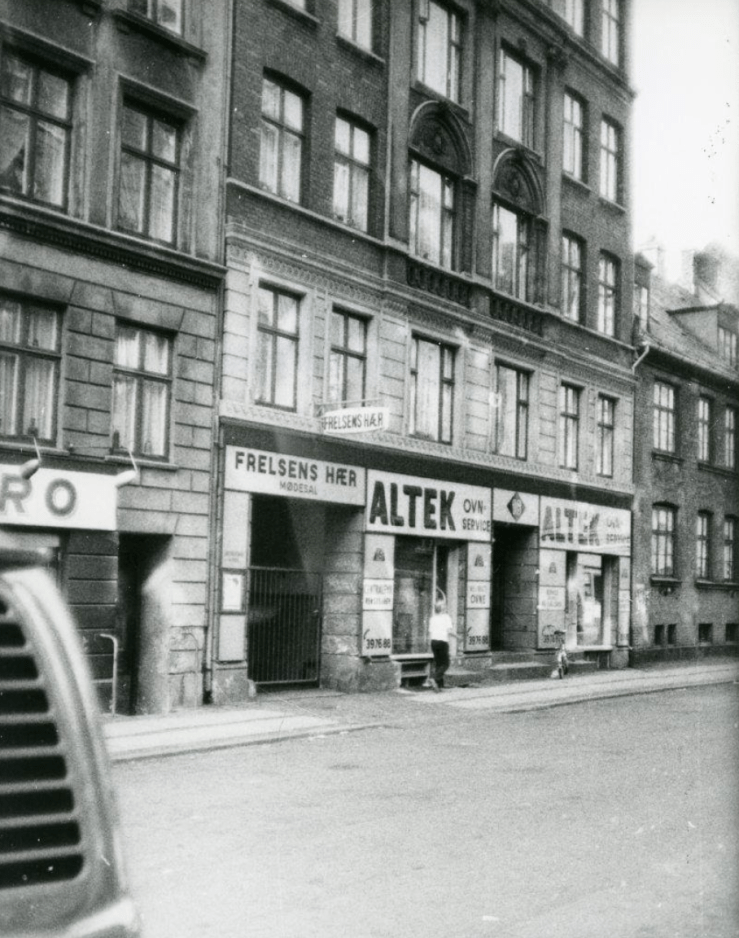
Frelsens Hær = Salvation Army
Gartnergade corps situated in an old working class district of Copenhagen has been the focus of a series of articles on the Danish site. There have been abstracts of these articles on the English site. The corps has had some unique research material as the corps history books have been fairly extensive narratives, especially in the years from 1925 to March 1948. The writer of the books was the Corps Secretary, Agnes Schrøder. When she started the book in 1925 she used whatever material she could find to give an account of the corps from its start in 1897 to 1925, among this her own experience as she visited the meetings soon after its start as a 14 year old girl and became closely connected to the corps through soldiership. Apart from the history books a journal from the youth fellowship gave accounts of all gatherings from 1943 to the mid fifties. Added to this have been reports in the War Cry (Krigsråbet) as well as statistic material plus Soldiers’ Rolls, Sunday School registers etc. The corps reflected the district as a working class corps, the soldiers both worked and lived in the neibourhood.[1] The district changed character through the 1960s and 1970s as a number of people moved out from the district to better housing at the outskirts of Copenhagen and so did a number of the soldiers. Those who had moved out started pendling to the corps. In the late 1970s a new plan for the district was made as the municipality decided to demolish a number of buildings to give more space between the old buildings, to renovate these as well as building new houses of a better quality. This plan included the corps buildings which eventually would have to be pulled down. The plan for the district resulted in many more people movng out before the actual changes started and squatters and other young people moved in. The corps continued its traditional program of meetings both indoos and in the open air. It still gathered quite fine congregtions for its indoor meetings and activities, but problems arose for open air ministry and especially marches in the district. For a number of the youngsters the Army’s military fashion and uniforms provoked their anger most probbly because of their continued conflict with the police and the resemblance between the Army’s uniforms and those of the police. The youngsters’ response could be throving eggs, tomatoes, screws etc. at the band. None were seriously hurt, but uniforms often had to be cleaned. At the same time a number of immigrants from non-western countries moved into some of the new buildings.
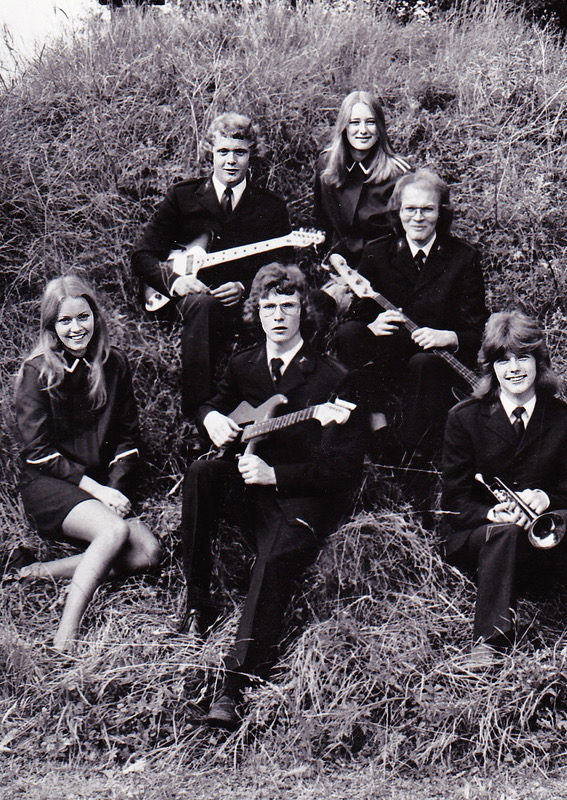
“Pegefingeren” – Gartnergade Youth Group
The corps continued to try to live up to its mission and arranged youth nights with modern music and small rythm groups, busses to take children to Sunday school from new housing estates etc. Through all this they did reach out to some of the youth and some children, but not long term. The identification between people of the district and the soldiers had dissapeared. The corps struggled to communicate with these new groups of the district, even though they engaged themselves by giving of their time and resources, they did not really succeed.
A lot of effort was put into finding new premises or building sites to build a new corps in this part of Copenhagen, but all in vain. Eventually the corps decided to moved to another district of Copenhagen, Valby, where the Army had a little corps and an old corps building[2]. That was demolished and a buildings site next to it was bought, so a new and spacious corps building could be errected. Through negotiations with the municipality it was made possible for the corps to stay in the old buildings untill the new corps was ready. Groups in the corps worked with the architect to get a multi-purpose building and other groups worked with the future programme of the corps. The corps moved into the new building in April 1983 and started the work in the district[3]. It became a community corps with ’Open house’[4]activtities during most days, telephone service during nights, an after school club for children as well as the normal corps activities such as junior club, scouts and guides, youth groups, YP band and songsters, Sunday school, Home League, Sunday services, band and songsters. The soldiers resembled people of the district and were able to engage themselves as a corps in the same way as they originally used to do in Gartnergade. The corps suceeded in its involvement in the district and became a natural part of it as a Salvation Army church.
Its mission and eccelsiology could be revitalized again in its full extent.
The Salvation Army’s overall mission and structure
As part of the international Salvation Army all structures and mission were in place when the Army became rooted in Denmark. As a hieratical faith community with a clear and visible structure and way of command it was transferred from one country to another. Everybody shared the overall mission to preach salvation and conversion for all. In the halls this mission was clear as it was painted on the walls – Denmark for Christ, or Nørrebro for Christ, Odense for Christ, denpending of where the corps was situated. The Salvation Army was a mission movement, that created corps with the same overall mission. The three fold slogan – soup, soap and salvation gave an indication of the extent and scope of salvation. Salvation was not only salvation of the soul or a spiritual aspect alone, salvation was for the whole human being, body and soul, because the human being is a wholeness. All men are created in the image of God and that gives dignity to all. Salvation is to be restored in one’s dignity as a human being and be included in fellowship and society – that is the soap. Salvation is to be restored to a life where the neccesities to maintain life such as food, clothing, housing and the possibility to contribute to the fellowship of society through work or other engagements –that is the soup.Salvation is to be restored to a life with God, where sin and shame have been deleted through Jesus Christ and his atonement. Salvation and justification happen through faith in Jesus Christ as saviour. As people who have experienced restoration and salvation the call for Salvationists was and is to express this new life through testimony(martyria), fellowship (koinonia) and service (diaconia).
The different corps will have these three fundamental elements. They are not always present in equal terms. It can happen that the aspect of fellowship is stronger that this to be in mission, or that the social outreach overshaddow the worship life and discipleship teaching, or that the internal fellowship is closed and selfsufficiant being blind to and not alert for the social challenges of society. In spite of these differences a touch of all three will be present at least as a challenge to take them seriously. That challenge will always be there for the corps to express.
Gartnergade corps and its endeavour to be a visible and clear expression of Salvation Army ecclesiology
Looking into the corps history books it is clear that the Army’s overall mission was visible and dominant in the corps through its worship life, its fellowship, its missional outreach and its great engagement in the area and in the people who lived there, both young and old. The corps was a living testimony to the love and grace of God and his salvation through Jesus Christ. It visualized in concrete acts the meaning of soup, soap and salvation.
The district had developed as Copenhagen expanded from being a town within ramparts to open these up to etablish industry as well as housing outside them. Industry had already moved outside the ramparts for a long period, while from 1852 to building of housing really started on a greater scale. The cholera epidemy broke out in Copenhagen among its 220.000 inhabitants around this time, and the building activities expanded rapidly because of the realization that the squeezed housing and stuffy air within the ramparts were unhealthy so was the open sewerage system which was reformed as well. The number of people who had moved out to this district was already in 1857 10.000 which rose to 52.000 in 1880 and to 105.000 in 1901. The corps opened its work in 1894 and became part of this rapid expansion. The houses were build very close with one, two or three backyards of houses up to 4 or 5 floors plus a loft where people also would be living. The flats were small and crowded. The Army had already a slumstation and creche there when the corps opened.
The corps developed its ministry here and it is clear from the corps history books that the corps was alert to the poverty and needs of the people and involved themselves in different ways. A lot of fundraising was neccesary in order to finance all the many activities for children and youth, unemployed people as well as elderly people. It included close contact to shops and industry in the area who gave goods for the different fundraising fairs and bazaars, as well as for the different dinners and parties for these groups.
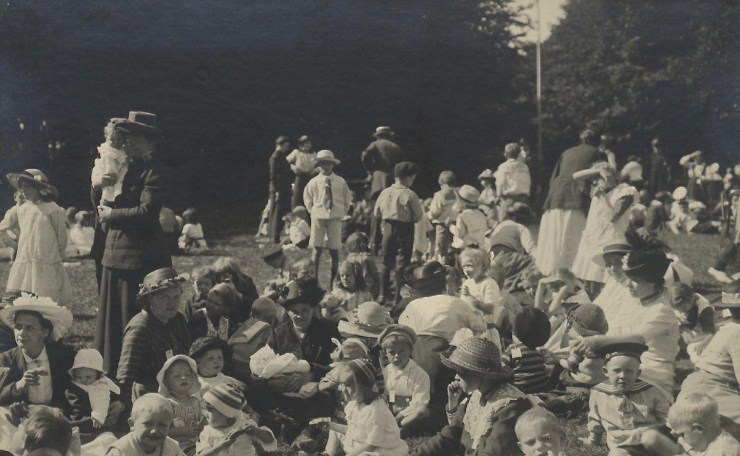
Corps outing for a 1000 children 1924
It is facinating to follow different initiatives from the history book, a special one shows the involvment of everybody in the corps. It happened 5th August 1924. The corps wanted to do something for the young children between 3 and 7 years of age – preschool age as the children normally started school at 7. This group were especially neglected, left on their own without many adventures. The corps decided to make an outing for 1000 children of that age. Firstly they had to raise funds for this. One of the means for that was for the songsters and another musical groups to travel to different parts including different beaches of Corpenhagen during the summer months. After work in the evenings they would have open air meetings with a stress on fundraising. The corps officer would tell the congregation of the plans with the outing, and the public listening to the songsters were convinced of the neccesity of this plan. They really gave a lot of money. The corps did these open air meetings several times a week, so it was a real effort. When they could see that it would be possible to finance such an event, a number of soldiers started to visit families in the district knocking on all doors in the densly populated district. People were so happy of this possibility so the thousand children were easily found. Then the planning started: 10 soldiers would be in charge of 100 children. They each had 10 other soldiers as helpers, so each person had the responsibility for 10 children. The helpers should carry a number and each of the ten children in their care eshould have the same number. The children would be travelling by trams to a train station and then continue the travel by train. The traffic compagny who ran the trams as well as the one with the trains were contacted and the logistics planned, including economic support from these resulting in reduced prices. All the children should meet seven o’clock in the morning of the day. Gartnergade was crammed with people: parents, sisters and brothers as well as the children… and all the helpers. The travel went well even though all traffic had to stop when 1000 children plus helpers as well as some sisters and brothers, in all between 1100 and 1200 should change from tram to train. When they reach the littel seaside town, Dragør, they all marched to the hotel at the beach where the outing should be. All children should bring their own cup and spoon. During the day the children were served ricepudding (a dinner dish) with juice, and in the afternoon warm chocolade and cakes. They were playing all day at this beach, untill they had to return by the train at six in the evening. It was a very great event for the corps and they all felt it had been a blessed day without any accidents.

Through all these activities the corps really lived out its call to diaconia. This practice of involvement in the lives of people visualized what soldiership was all about to the youngsters growing up in the corps, so this heritage went from one generation to the next.
In all its outreach to the district the two pillars of witness and diaconia were very clear through the involvments with the families of the children who came to Sunday school and all the other youth activitties. The youth workers visited the homes when the kids had been absent from Sunday school or when they were ill or celebrating birthdays. The visits could also be concerning juniorsoldiership or soldiership, if the children wanted to become either juniorsoldiers or later soldiers. The youth workers were welcomed into the homes and the parents trusted them. Many talks concerning these two issues would concentrate on salvation, faith and discipelship.. and the sincere witness from the youth workers through word and deed were often convincing testimonies for the parents. Especially concerning soldiership a number of parents felt their children were too young at the age of 14 and wanted them to wait untill they were more mature, but they were still allowed to participate and engage themselves.
The mission and witness of the corps were visible throughout the open air ministry in marches, open air meetings as well as the smalller meetings in the yards between the housing blocks.

At the indoor worship life through the public Sunday meeetings as holiness meetings and salvation meetings the breath of salvation and holiness was communicated through sermons, testimonies, songs and music. It visualized the Christian fellowship and discipleship for all who participated in these. The warm and welcoming atmosphere of the meetings drew a number of people into the corps either as friends or soldiers.
Another feature that strengthened the fellowhip and road of discipleship was the united holiness meetings with other Copenhagen corps. They were usually held on Wednesday nights and for years from 1902 to 1948 they were held in Gartnergade corps, later they moved to the Temple corps, but still held on Wednesday nights. It strengthened the fellowship between the different corps. It seemed to be a treasured gathering which can be seen by the fact that Wedensday 10 april 1940, the day after the German troops had occupied Denmark, a great number of people joined in the meeting. The windows had to be blacked out, so the corps was busy to get this in order while Nazi soldiers were all over Copenhagen. The corps succeeded and the meeting went undesturbed under the leadership of Commissioner mrs. Agnes Poulsen.[5]
Fellowship and discipleship were further developed through the focus on the payer life of the corps. Prayer was part of every gathering throughout the week, whatever kind of gathering it might be. The richness of prayer choruses was there to support the prayers before going out into the streets or before a practice of any of the musical sections or youth activities. Now and then there would be half nights of prayer starting around 8-9 in the evening and lasting till midnight or early morning prayers from 6 or 6.30 and lasting half an hour before people went to work especially during the Selfdenial week
The central role of the mercy seat
Living in a Lutheran country most of the soldiers would be members of the Lutheran Church like the vast majority of the population. They were familiar with the sacraments of the church and the centrality of communion in the Sunday morning service, but there was no tradition for participating in church services[6].

Salvation for all!
For salvationists the mercy seat had this central role in both holiness as well as salvation meetings. The mercy seat would always be placed in front of the platform, and for years in Gartnergade corps it would be two white benches on each side of the rostrum. They were placed on a raised platform covered with carpet. On the rostrum the text God is love was painted and above the benches these two texts were painted. On the one side My Grace is sufficient and on the other There is salvation for all. All three texts underlined the core of Christian faith and the scope of salvation. God who himself is love and not just has love for all, salvation given by grace including everybody without distinction. On each corner there would be a pole and between the poles there would be red cords, which visually separated this place from the hall. It signalled that this was a special place, a holy place. Nina Lauridsen[7] who came to the corps as a young teenager through one of her schoolmates, told about the feelings that stirred up in her, when the prayer meeting after the sermon started. The Corps Sergentmajor would go down and remove the cords, so there would be free access. Her reaction was: ”Now it happens!” May be the holy moment, that came about, nearly something magical or mysterious. At least for her there was an expectation, that something special would happen.
The invitation to come forward to the mercy seat would always be part of the meeting and come after the sermon. This time of prayer and reflection could be shorter or longer. Especially during the salvation meetings at night it was often fairly long from ten / fifteen minutes to half and whole hours. The hall was filled with prayer, some would rise and pray loudly, other would go forward to the mercy seat and kneel down, while other would be sitting at their place praying in silence for those who were seeking God at the mercy seat, for themselves, for others in the congregation or whoever the prayer would include. There would be quiet singing of prayer choruses during this time. The variety and number of prayer choruses illustrate how important this time of prayer and reflection was and is. The mercy seat was the center and many would make use of it. When a person came forward to the mercy seat for prtayer, one of the officers, a local officer or one of the soldiers would come and kneel next to them and offer help and prayer. It could also be two persons going forward together to pray. In that way the mercy seat also became a place for cure of souls or as a confessional. It would often demand courage to go forward and kneel in public, especially if Army meetings and symbols were unfamiliar. For newcomers who perhaps were kneeling for the first time or praying for the first time, it was a strange situation, but the fact that somebody would kneel and prayer together with them would most often be a strength. It was also possible to be able to pray alone, if so desired.

In Danish the mercy seat is called the penitent form and by this the role of a confessional has been underlined. It was and is often a confessional, but not to the extent that the Army is practicing the sacrament of confession as has been suggested by people describing the Army.[8]
The name mercy seat express a belief that this place is a visible sign of God’s mercy which includes everybody and is mediated directly through prayer. People experienced/experience God’s grace and presence and the indwelling of the Holy Spirit. It is a place ”to feed opon Christ” and experience his real presence and therefore close to the place of the Eucharist. It is a spiritual communion, but also a concrete act in a concrete place, a special one where the body is engaged by moving and kneeling as well as experiencing fellowship by another person kneeling and praying. Added to this came the support of the congregation through songs and prayer. This sign of God’s mercy was underlined in the special arrangement of the mercy seat with painted texts, the white benches and the cords that were removed when you reach the prayer and reflection time in the service. It underlined the experience of the presence of God nerly as something mystical, as Nina expressed: ”Now it happens!”
The enrolment of soldiers
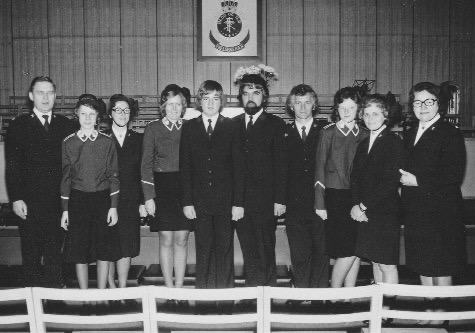
If prayer at the mercy seat can be regarded as a Communion, the Soldier’s Enrolment or Covenant can be perceived as a Baptism – a baptism of believers. Before the enrolment the soldiers will dress in uniform for the first time. This change of dress shows that the soldiers changes from just being a private person, to person in the service of God. The Salvation Army flag symbolising the triune God will be held over the soldier while she/he publicly declares her/his faith in God, testifies to salvation through Jesus Christ and make the vows that belongs to Salvation Army soldiership. Then the soldier will kneel and a prayer of strength in service and blessing over the new life will be offered. As a conclusion the Soldiers Covenant will be signed. It confirms the new status as a soldier of Jesus Christ in the Salvation Army. It is like a baptism into the body of Christ, an underlining of a sacramental life, a practical, close-to-earth life. A life in service of God and man, where witness (martyria), fellowship (koinonia) and diaconia is included.
The promises in the covenant are overwhelming, but it is a mercyfull God who receives all the good intentions and promises. When ordinary, frail women and men dare to sign this covenant, it is on basis of a strong faith in God’s forgivness and mercy in times of defeat, and a faith in the presence and power of the Holy Spirit to live the Christian life.
Diaconia as the central commandment from the Gospel of John 13. 12-17
In the majority of the churches in the world the sacraments are constitutional for being a church. The Lord’s Supper as instituded by Christ during the Last Supper and described in the gospels of Matthew, Mark and Luke is considered essential for being a church. In a way diaconia has found its central place as constitutive of being a church in the Salvation Army. For Salvationists the description of the Easter Meal in the Gospel of John is a strong call for being a Salvation Army church. In the Gospel of John there are no words of instituion concerning the Lord’s Supper, instead Jesus washed the feet of the disciples. In chapter 13. 12 – 17 the meaning of this is explained: ”When he had finished washing their feet, he put on his clothes and returned to his place. ”do you understand what I have done for you?” he asked them, ”You call me teacher and Lord and rightly so, for that is what I m. Now that i, your Lord and Teacher, have washed your feet, you also should wash one another’s feet. I have set you an example that you should do as I have done for you. I tell you the truth, no servant is greater than his master, nor is a messenger greater than the ond who sent him. Now that you know these things, you will be blessed if you do them.”
This symbol of diaconia, not as a concrete act of washing feet, has been a central commandment to Salvationists as a guide for living sacramental lives. The moment this call disappears and is overshadowed by worship and fellowship alone, however strong and beautifull it might be, the sacramental life as a Salvationist suffers and so does the genuine witness to the world.
The impact of changed living condition in society as well as in personal lives
During the time of transition of the district around Gartnergade with people who used to be part of the district moving out into the outskirts of Copenhagen including a large number of the soldiers the ministry of the corps also changed. As the district no longer was the place where the soldiers lived their everyday life, they became disconnected from it. It was still the focus of their corps engagement and their soldiership, but only on Sundays for the meetings, indoor and outdoor, as well as for practices in the band or songsters or other activities in the corps they were engaged in. They absolutely fulfilled their callings as soldiers, but their everyday witness through work and being neighbours had changed. They gladly gave their testimony at the open air meetings and in the hall, but it was difficult to communicate.
Not only did the disconnection from the district in their everyday life, but also the general secularization of people and society have influence, because the traditional way the corps used to communicate, no longer got the same response s earlier. The message seemed not to be as relevant for people’s lives as the resonator for a message of salvation/conversion had lost its base. The general secularization affected a number of ordinary people so they turned away from a belief in God and from practising their faith by attending places of worship. It would also include ceasing to interpret their lives, their moral, spiritual, and religious experiences in the light of the values of the Christian faith. Salvationists were not immune from the general secularization either. They, too, experienced that belief in God was not so easy to embrace among all the influences that were around them[9]. Because of these changes the corps seemed to turn its attention toward its own values and search for identity.
All this made the fellowship aspect of the corps dominant. It still tried to live out its overall callling to mission through witness, which can be seen in the different endavours to try to reach out to the district and in the discussion of how to respond to this new situation. The aspect of diaconia had nearly disappeared. It was there as an undelying call and a willigness to engage in people who asked for help or in the youth work which was still there.
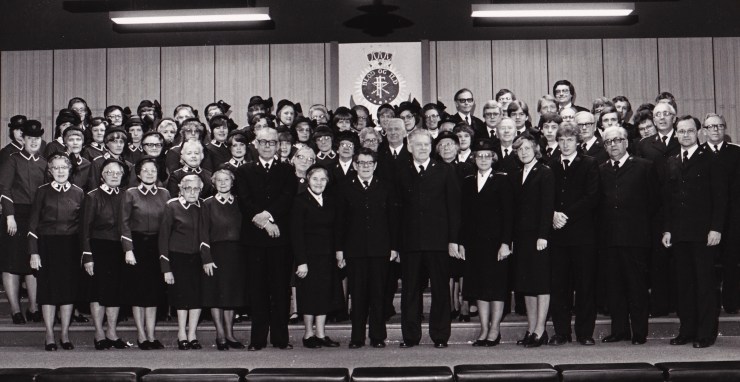
Last picture at Gartnergade before moving to form Valby Corps 1983
The corps that moved out to Valby had been focussed on internal matters with a strong fellowship. Through this it developed its discipleship and search for identity. This focus had prepared the corps for the new situation. When the decision of the location of the new district had been taken the corp had two years to prepare for being corps in the new district through brain storming, working groups as well as numerous visits to the distric of Valby with leaflets and door to door contact.
It was as if the move released a lot of energy and the deep wish to live out its mission of martyria, koinonia and diaconia came into bloom. The corps used this time of kairos well.
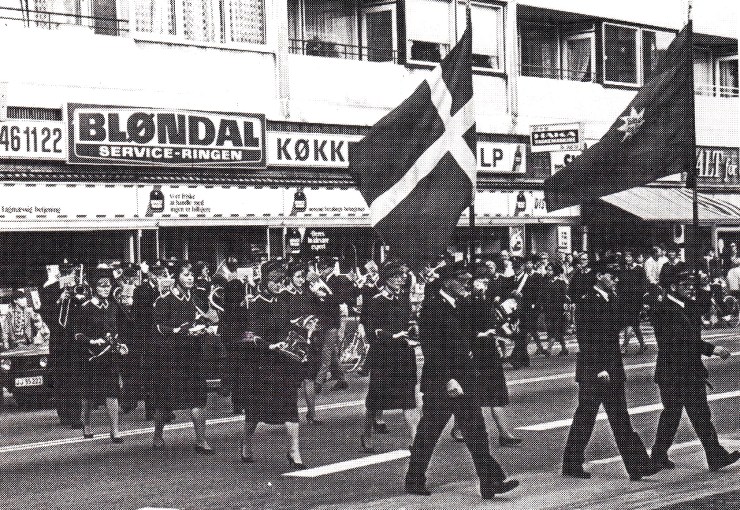
Marching into the new Hall at Valby 1983
[1] This could be seen from old Soldiers’ rolls, where we had the addressses and form accounts which appeared now and then of their work life. A number were artisans and workmen, postmen, traffic wards and the women were house wives, servants and maids, fatory workers, nurses and nursury workers.
[2] My husband and I came home from London where we had been corps leaders in Chalk Farm corps for a couple of years to take over Gartnergade corps and find a solution for its future. We stayed in the corps for seven years. The two first years in finding the solution and building the new corps and then five years to accomodate the corps program in this new district. All soldiers (200) followed to the new corps, now called Valby corps.
[3] Since the decison was taken to moved to this new district the corps had been making research into the district as well as making plans for future activities. They visited housing blocks round the new corps with leaflets and door to door contact.
[4] Open House was held during mornings and early afternoons three days a week plus Saturday afternoon. Food was served and fellowships created between vulnerable people. The usual attandance would be between 30 and 50 people a day. There would be devotions at noon these days. Also the devotions attracted a good number all opening days as people were involved in finding songs and giving comments to different bible readings. The congregation was a mixture of people of all ages some with alcoholproblems, homelessness or loneliness. Many elderly people without any or these problems found it an exiting compagny. When meeting some of them on the streets they called it to come to church. A number of soldiers who has just retired from their work life engaged themselves in this work.
[5] At this stage Agnes Poulsen had retired and returned to Denmark. She was one of the early officers in Denmark and with her husband pioneered i Russia (1910-12), was in territorial leadership In Finland, Norway and Holland, where her husband died. She continued as leader of Womens Social Services in Sweden and United Kingdom. In retirement she represented the Army at the League of Nation in Geneva and conducted evangelical campaigns in different countries as well as in her native Denmark.
[6] Their membership came through infant baptism which they themselves had been brought to the church for and which they brought their own children to for the majority. Most officers and a number of local officers did not continue this practice, but brought their children to the Army for the dedication ceremony. The confirmation was and still is so much part of Danish culture that most salvationist children were confirmed in the church. At least untill The Army in Denmark started with confirmations around 1970. See Gudrun Lydholm, Lutheran Salvationists?
[7] Colonel Nina Lauridsen became a soldier in Gartnergade corps in the 1950s and engaged herself in the youth work of the corps. Her husband, Jørn Lauridsen was the YP Sergent Major. He went to the training college and so did Nina after her training as a nurse. After their wedding they served together different places in Denmark, at IHQ and lastly as territorial leaders in Germany.
[8] Michael Neiiendam wrote in 1939 a book concerning the Army as a faith commmunity and in this he focused on the penitent form and his understanding of the Army as practicing the sacrament of confession. Firkirker og Sekter Vol.3, p 188. København. C.E.C.Gad, 1939
[9] See Lydholm, Lutheran Salvationists? p. 54-55
 Salvationist viewpoints