Paper delivered at St John’s College Durham 11th-13th September 2012
The Salvation Army began its work in Norway in January 1888. The Lutheran State Church was the dominant religious and cultural institution, especially at this time of building up the nation to gain its full independence. That happened in 1905. A law protecting the rights of dissenters had been passed through parliament in 1845 so dissenters had freedom to resign their membership of the State Church and to refrain from having their children baptized there. The Church was considered an integral part of the nation. The norm for a Norwegian citizen was to be a member of the State Church. This culture of national and religious unity was the setting for the Army’s pioneering work of mission, evangelism and the stress on personal conversion. It brought with it a different, perhaps even an alien concept of Christianity.
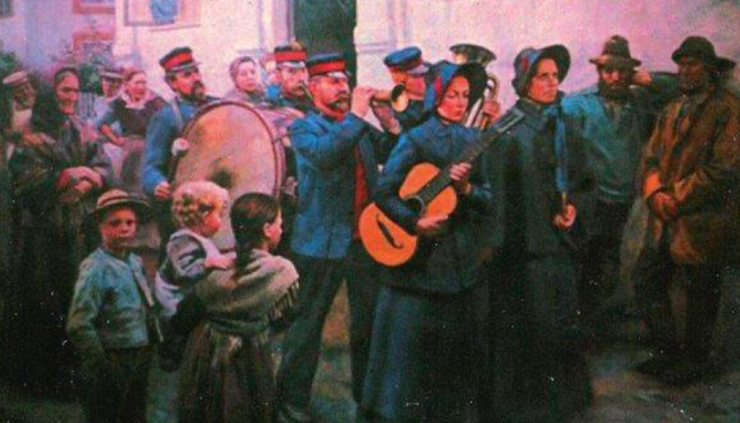
At the time of pioneering the Army’s work in Norway the international Salvation Army had settled different issues concerning its identity, mission, and ecclesiology – (ecclesiology was never used as the claim was not to be a church). The most important issue for this study was the decision not to practice the sacraments. The pioneers and the first generation of Norwegian Salvationists were grounded in Salvationist Doctrines, its focus on mission and its teaching regarding the sacraments that led to non-observance. As far as I can gather from historical sources the officers dedicated their children in the Army and abstained from having their children baptized in the State Church[2]. They dissented from the ‘normality’ in that way.
The situation changed around 1913 when the Army celebrated its 25th anniversary. In 1913 the Army in Norway published the first translation of the Doctrine book[3]. It differed from the translations in the other Nordic countries such as Denmark, Sweden and Finland, because it translated the English 1881 doctrine book that included reference to celebrating the sacraments. (The Salvation Army came into its position of non-observance in 1883). In the years since 1881 there had been seven other English editions, when the Norwegian translation came. It must have been a deliberate choice to go back to the edition before the Army altered its position towards the sacraments.
It seems that the tradition among Salvationists in Norway to have their children baptized in the State Church before dedicating them in the Army started in the first part of the 20th century. A tradition of dual membership and dual affiliation that has been the norm until recently. As far as I can judge from historic sources this change did not alter their beliefs. They did not adhere to the Lutheran belief concerning baptism, but kept the Army’s position.
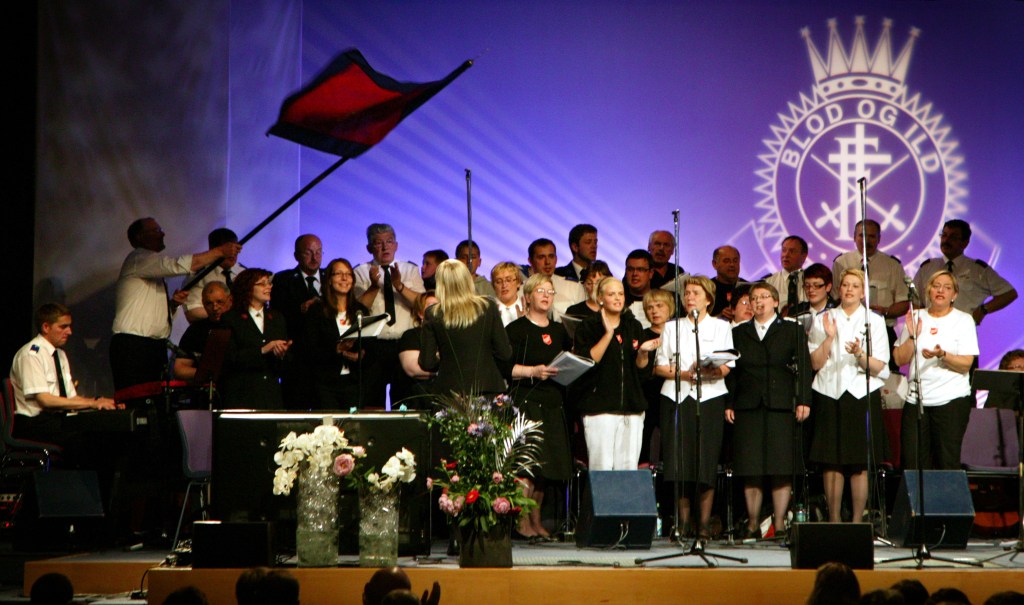
Salvationists at a congress for the territory Norway, Iceland and the Faroe Islands (War Cry Norway)
The 1881 doctrine book[4] explains what was the belief concerning infant baptism, the Army practiced at that time, and for the administration of the Lord’s Supper, that used to be a monthly celebration. The paragraph in the Doctrine Book explains baptism in this way: “As a form by which the parents or guardians of children may consecrate and set them apart, and declare their intention of training them up for God and The Army.”[5] The paragraph continues with the question as to whether baptism is a duty that must be performed: “Decidedly not. The Army considers one baptism essential to salvation, and that is, the baptism of the Holy Ghost”[6]. Concerning the Lord’s Supper it is stated: “When such an ordinance is helpful to the faith of our soldiers, we recommend its adoption.”[7] On the question if this is essential to salvation the answer is: “Certainly not. Only a holy life, the outcome of love to God and man, attained and maintained by the power of the Holy Spirit, through faith in the blood of Christ, is essential to salvation.”[8]
I think it can be argued that The Salvation Army in Norway took up the tradition from before 1883 and kept it alive, not by administering the sacraments within the Army, but by making use of the sacraments in the Lutheran church and giving them a Salvation Army interpretation. In effect, Salvationist faith – Lutheran praxis. In this they overlooked what was the essence of the Lutheran belief, but their rationale for doing this might have been for better enculturating the Army’s approach to mission. My reasons for that conclusion are as follows:
Norway became independent in 1905[9] after nearly hundred years of nation building where an integral feature was the closeness of church and culture, a symbiosis of the two. Part of the identity of a ‘proper’ Norwegian citizen was membership of the State Church. Inger Furseth in her comparative studies of social and religious movements in Norway[10] argues that “discontinuity with the established religious tradition seemed to prevent movement growth.”[11]She enlarges this point concerning Methodism: “When the ideological differences became apparent, Methodism seemed more discontinuous with conventional Lutheran culture and became a somewhat alien element. The movement suffered when it asked the State Church members to reject their religious heritage. It was defined as too deviant, and this factor prevented movement growth.”[12] Looking into the Labor Movement she finds that generally the workers, even some of the leaders did not sever their bonds to the State Church in spite of the fact that such an action was encouraged.[13]
I cannot find documents that support a deliberate decision on the part of The Salvation Army apart from the choice concerning the translation of the Doctrine book. I think the change happened little by little. I can see from a diary[14]covering the years from 1904 -14 from one of the first officers that their son was baptized the day before his confirmation. Together with him the other siblings were baptized. The wish to be confirmed – another very strong identity building feature in Norway – could very well have been the start for some individuals.
When the new and different Doctrine book was translated in 1930, the whole section on the Army’s stance on non-observance of the sacraments was omitted. Only in 1975 did they start to use a translation that included The Salvation Army’s reasons for not practicing the sacraments. Even then this was not widely taught or disseminated. From having a translation of the 1881 Doctrine book to support the Salvation Army’s original views on the sacraments to utter silence on the issue to a reluctance to give proper teaching when published gives an indication of how the ordinary ecclesiology of the Lutheran State Church trumped the official ecclesiology of the denomination in the interest of enculturating the Salvation Army approach to mission. The Lutheran idea of church proved more important than The Salvation Army’s own.
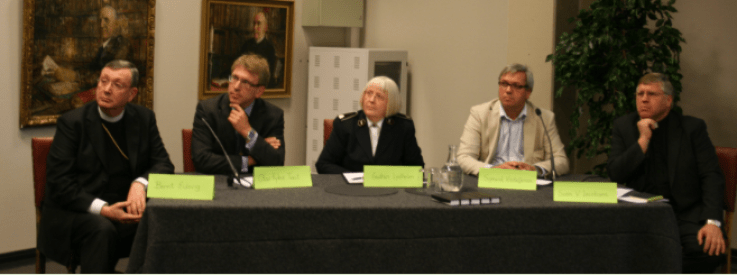
Ecumenical Council of Church Leaders Norway 2006
When the Army started the process of looking into possibilities for a legal registration as a church in 1975 the reason was the work of the different commissions[15] the Lutheran Church and the State had initiated to look into the situation of the church and later a separation between the state and the church. It was not the burning issue from the Dissenters’ Forum of a wider law concerning faith communities outside the State Church[16] that spurred the work within the Army, but the anticipation of a separation between state and church. Apparently it was the State Church the Salvationists adhered to, not the Lutheran part. This supports the claim that they retained Salvationist faith. It also supports the fact that the dual membership was linked to being a Norwegian citizen and so not dissenting from the dominant culture/religion for mission purposes. The denomination could downplay its own ecclesiology as long as the dominant ecclesiology had its foundation in the merger of state/church, but not when it became purely Lutheran.
The present situation is that cultural Lutheranism as part of national identity is still strong with 77 % of the population as members[17] – the Norwegian Salvation Army registered as a church in 2005[18] – but only 15% of the soldiers gave up their State Church membership to join the legal registered church part of the Army[19]. For couples – generally the man chose Army registration, the woman to remain a Lutheran. That the women – the intermediaries of the culture – stayed within the church does indicate the strong bonds and the strong wish to stay within the dominating religion/culture. All Salvationists stress very much that they belong to the Norwegian Salvation Army, even though they do embrace the internationalism of the Army. This ‘embrace’ is illustrated by the generosity of the Norwegian Salvation Army – it is among the 12 Salvation Army territories that traditionally have financed the Army mission around the world. However, financial generosity is also a mark of Norwegian culture/religion.
[2] I base this on research of a census from 1910. I had the address of Salvation Army property where a number of officer families were living at that time. The officers were stated as ‘having left the church’ or as ‘no faith community’. In the personal papers of Commissioner Håkon Dahlstrøm I found a correspondence where he objected to the Army’s teaching on the sacraments and told that he as an officers’ child had not been baptized as an infant, but later in life (40 years of age) was baptized. He was born in 1906. His younger sister is still alive and she confirms that none of her siblings were baptized as infants. An interesting comment is found in Dr. theol. Sverre Norborg’s book “Seksti selsomme år” (Sixty strange years). He writes about his officers parents who were ’sneaking’ to the church on a weekday to have their child baptized. It happened in these first years of the centenary. This proves that it was not ‘the done thing’ as they didn’t want anybody to know.
[3] Frelsesarmeens Læresætninger, Kristiania. There is no publishing year, but from the SA archives in Oslo I get the year 1913.
[4] The Doctrines and Disciplines of The Salvation Army. Prepared for the training Homes by order of the General. London 1881
[5] Ibid paragraph 26
[6] Ibid paragraph 26
[7] Ibid paragraph 26
[8] Ibid paragraph 26
[9] Norway had been in union with Denmark pleading allegiance to the Danish king for more than 400 years. At the Peace Treaty in Kiel in January 1814 Denmark had to surrender Norway to Sweden. The Danish governor in Norway then called a council of magnates at Eidsvold to lead Norway to independence. This first council developed into a constitutional assembly. The assembly worked with a Norwegian Constitution that was signed 17thof May by the governor. The governor who by this act was made the king had to leave in October and the allegiance was eventually given to the Swedish king in November the same year. In the years from 1814 till the independence from Sweden in 1905 a nation building took place.
[10] Comparative Studies of Social and Religious Movements in Norway 1780-1905, Lewiston, NY, Edwin Mellem Press 2002
[11] Ibid p. 384
[12] Ibid p. 384
[13] Ibid p. 334
[14] Frelsesoffiser nr. 6, Historien om Kristine Saksill – mor og pioneer. Frelsesarmeen Oslo 2010
[15] Reform Commission of 1965, Research Commission of 1971, both from within the church. The reports of these two commissions had the focus of the church as a community of faith and on ecclesiology. The Public Commission of1971 gave its recommendation to be sent out for hearing in 1975. The majority of the commission supported a separation between church and state.
[16] Lov om trudomssamfunn og ymist anna av 13. juni 1969 (Law on Faith Communities from 13th June 1969)
[17] 84,9% in 2006, 82,7% in 2007, 81,8% in 2008. The 77% is from January 2012. The 2012 figure I got on telephone from the Department of Church affairs. I have the 2008 year Book containing the other figures. The official explanation I got from the department is that immigration makes a difference as the percentage of the population that resign their membership is fairly stable.
[18] The registration was like the one ‘Missionsforbundet’ (a congregational free church) had chosen earlier on. They had faced a similar situation as the Army did – that a substantial number of their members had a dual membership – the State Church and ‘Missionsforbundet. The Salvation Army as such did not alter its registration as an organization, but a Salvation Army church was registered and officers, soldiers, adherents and friends of the Army could register as members. In order to register they had to resign their membership of the State Church.
[19] Looking into the number of officers who had registered by 2010 – 2/3 of them had left the Lutheran church to register.
(Featured image of article: Norwegian War Cry)
 Salvationist viewpoints