I love to live.This could be the heading of my life, a heading I am sure I share with a lot of people. A number of these would not make any confession of faith or make any combination of this love and God, the giver of life. Nevertheless, the sheer joy of life and love of life is an act of worship. It is a praise to God, the creator of all.
However, it is possible to identify worshippers who have no focus on God, but are worshipping into the blue without an object for their love and worship. It is also possible to identify worshippers who direct their worship to God, but have forgotten the strong link between love and worship, between their daily life and worship. It is an experience of liberation to discover or rediscover that our whole life is an act of worship, that our attitude to life determines our worship. Our Sunday or weekday worship is just a reflection or concentration of our life’s worship.
There is a rich blessing in store for us, when we start identifying holy moment of life as moments where God was present or where he interfered. It can be moments of clarity, of fellowship and sharing, of reconciliation and trust, of joy or pain or just sheer fulfillment of life. It might only be a few of us who today would write a poem as the one Agustine wrote called ’Holy moments of life’. We are not so familiar with using this language of love in our worship, perhaps because we have forgotten to worship God with our whole being. It has God as its object, is sensual reflecting the strong link between love of God and true worship.
Late have I loved you,
O beauty ever ancient, ever new!
Late have I loved you!
And behold
You were within, and I without,
and without I sought You.
And deformed I ran after these forms
of beauty You have made.
You were with me,
and I was not with you.
Those things held me back from You.
Things who’s only being
was to be in You.
You called; You cried;
and You broke through my deafness.
You flashed; You shone;
and You chased away my blindness.
You became fragrant;
and I inhaled and sighed for You.
I tasted,
and now hunger and thirst
for You.
You touched me:
and I burned for Your embrace.
St. Augustine
Built on the compassion and grace of God
In Romans 12. 1-2 Paul urges us to enter into an act of worship because of the grace of God:
Therefore, I urge you, brothers, in view of God’s mercy, to offer your bodies as living sacrifices, holy and pleasing to God – this is your spiritual act of worship. Do not conform any longer to the pattern of this world, but be transformed by renewing your mind. Then you will be able to test and approve what God’s will is – his good, pleasing and perfect will.
It is a worship encompassing both body and mind, a truly holistic worship. Our body with all its senses, with all its life we shall surrender as an unconditional gift, a holy pleasing to God. This is a metaphor of what true worship is. Instead of conforming to the spirit of the time we shall be transformed by a renewal of our mind to rethinking and to repentance. Through this act of worship and renewal we can judge what is the will of God. This is a strong description of our whole life lived as an act of worship. It rejects the idea of dividing our life into different compartments, for instance one for work, one for pleasure, one for our love life and family, one for friendships, one for studies and personal development, one for religious activities etc. Compartments which can be without any connection to each other, a way of living where worship is one separate compartment, instead of a natural part of life in all its diversity and richness.Our body, symbolising our daily life, we surrender as a gift, and we are encouraged to let our mind be renewed and transformed.These two aspects belong together, even though we tend to focus on the transformation of our mind forgetting the body part as vital for true worship and encounter with God. The all-encompassing renewal which alters our thinking only happens in connection with this total surrender. This is the aim of our holiness teaching, but even here the concentration has often been on the mind rather than the body.
Ten commandments for life
The people of Israel got ten commandments to direct them in order for their lives to be expressions of worship to God. These are part of our heritage as well and have given us a frame within which we can glorify God by our lives.
The German theologian, Jörn Zink, has written ten contemporary commandments based on his Christian experience. When he was 18 years old he gave his allegiance to the Nazi party against his Christian conviction. He became a prisoner of war. After his release he decided, that he would never again live with split allegiances. ” Until now I have lived a split life. From today I want to be whole.” He became a minister in the Lutheran Church. These commandments are refreshing reminders of how to live a life of worship in the presence of God.
- God is one. Do not place any human being in his place.
- God is all embracing wholeness. Therefore, you should not split yourself.
- God is near to you. Listen to him and give your answer.
- You don’t live isolated. There is fellowship around you to strengthen you. Participate in it for the benefit of others.
- God gives us life. Therefore, you shall help human beings and other creatures that they can live.
- If God gives you a human being to love, then honor that person. Help your partner to be the free person, God intended for him or her to be.
- God is the giving God. Therefore you shall not hold on to things.
- God’s truth shall come to people through you. Be like Christ for other people, true and merciful at the same time.
- The Kingdom of God will come. Act in a way that prepare his coming.
- God knows. Therefore be trusting and do not worry.
To have our sight sharpened
It can be seen as a cornerstone in our relationship with God to view our whole life and being as an act of worship. However, we need to build visible and concrete acts around this cornerstone, places where we meet and share fellowship, where we have our sight sharpened because we consciously seek the presence of God. As Christians we don’t just gather around some goal or mission, we share the life of faith. That is the essence of the New Testament word koinonia, which we translate as fellowship or communion. This fellowship is not our creation, but God’s. We are called into it. God who has called you into fellowship with his Son Jesus Christ our Lord is faithful.( 1 Cor. 1.9) As the spirit of fellowship God the Holy Spirit is the one renewing and guaranteeing this fellowship. What we have a share in is the love of God, the grace of Jesus Christ and the fellowship of the Holy Spirit.
Silence
The Orthodox Church calls itself the church of silence. Silence is seen as an expression of awe because God is in the silence (1 Kings 19. 11-12), not in the mighty manifestations. The silence is there as a condition for listening to God, as an expression of faith and prayer, because the essence of prayer is not so much our words, but an offering of ourselves and a willingness to listen.
All of us need time of silence where we step back, reflect and refrain from filling our time and space with activities and words. This is a vital act of worship in our daily life. This can be a fountain of new life and strength, but it doesn’t come that easily, because we have become strangers to silence. We need to learn to live with silence and to discipline ourselves for it, for silence can be frightening. Jesus calls us into his presence: Come to me, all you who are weary and burdened, and I will give you rest (Matt 11. 28). The grace and peace of God come when our minds are at rest in the middle of silence. Here our whole being turns into prayer, because we are in the presence of God in all our nakedness, our poverty, our nothingness, our sin and our destroyed and broken words and are given rest and peace.

Dag Hammarskjöld has in one of his poems in Markingsa prayer for the meeting in silence:
Have mercy
upon us
have mercy
upon the efforts
that we before Thee,
in love and in faith,
righteousness and humility,
may follow Thee
with self-denial, steadfastness and courage,
and meet Thee
in the silence.
Give us
a pure heart
that we may know Thee,
a humble heart
that we may hear Thee,
a heart of love
that we may serve Thee
a heart of faith
that we may live Thee.
Deliver us from evil.
Then
Whom I do not know
but whose I am
Thou
Whom I do not comprehend
but Who has dedicated me
to my fate,
Thou
Prayer
Prayer is not only silence, it is not only to receive and turn inward, but to bring into the presence of God our life and the world around us. It is a discovery of the reality outside ourselves, the reality of God. In this prayer or discovery there are three main components:
Praise – Criticism – Rest
An example of criticism is the prayer, deliver us from evil. It pinpoints that there is evil. The prayer makes a distance to that evil. It is like the prayers in the book of Psalms who are filled with criticism and with praise. Constructive criticism is impossible without praise, without dreams, hopes and experiences of good. Even if they are only glimpses they must be there to give a sounding board for the criticism. In the prayer life where these two components are, joy and pain can meet in the same person and be recognized in a way that life can be lived as a wholeness in spite of the conflicting powers of joy and pain.
The Swedish writer Sven Delblanc’s novel called Samuels døtre(The Daughters of Samuel) illustrates this. In the novel you meet a poor widow, Cecilie, who as a birthday present gets a very needed pair of glasses from her children. These glasses become both a joy and a pain. Her sight improves, she can see what is happening around her, and her work gets easier, but at the same time she is now able to see the bitterness and poverty in the faces of her children. She notices the hopelessness. She turns this experience into prayer: Don’t make the world so cruel, that I want blindness as a gift! That is all I dare to pray Thou good and merciful God!
Her prayer is like the old Biblical prayers which contain a cry for help and for a more just world. She doesn’t ask for liberation from the sharp and clear sight that notices both joy and pain, but that she will never reach the point where the pain and cruelty is her whole horizon.
Our prayer life both the individual as well as the corporate could be illustrated by such a pair of glasses. From prayer and through prayer we get a sharp and clear sight to see our own reality as well as the reality of God’s world around us. Such a pair of glasses do keep both praise and criticism in focus.
There is a third important component of prayer which is the foundation for all prayer and worship. That is rest.To rest in the assurance that God is …, that God is present…,that God is ahead…,that God is above, behind and underneath the abyss of doubt and despair. This is how we know that we belong to the truth, and how we set our hearts at rest in his presence whenever our hearts condemn us. For God is greater than our hearts, and he knows everything. ( I John 3. 19-20)
Models of prayer
We have a strong tradition for personal, spontaneous prayers in our worship to the exclusion of written, liturgical prayers. Our tradition is of great value and should be nourished in the teaching of our people from early childhood or early Christian life as it is a source of power and new life. Even though that is our priority, written, liturgical prayers can give an immense impact in a worship setting and be means of blessings as well as teaching tools in our quest for a dynamic prayer life. We can draw upon resources from the whole history of the Church as well as write them ourselves and ask our people to write prayers for use in worship.
Another type of prayer is contemplative prayer or meditation which for many in our setting is felt as alient in our worship life. This is partly due to the use of silence, but that is not the whole picture. It can be arranged as part of worship. The goal is to go beyond our words in order to communicate with our other senses. It can be to focus on images or pictures and let our prayers flow through our sight. It can be to listen to music and let our prayers flow through our hearing. It can also be complete silence with nothing to feed our senses apart from the presence of God.
Intercession is part of our traditional prayer life and it can never be strengthened enough. It is an act of love when we push our own needs aside and place others at the center of our attention to bring them into the presence of God. We need intercession for each other, for the Army world, for the secular world, for the future, for the consequences of the sins of the past, for protection and courage. The prayers need to be specific, not for the sake of God, but for our sake that we keep focus and learn to leave everything into the hands of God. As part of our intercession we can rejoice in the fact that we are not alone in our prayers, the Holy Spirit intercedes for us:
In the same way the Spirit helps us in our weakness. We do not know what we ought to pray for, but the Spirit himself intercedes for us with groans that words cannot express. And he who searches our hearts knows the mind of the Spirit, because the Spirit intercedes for the saints in accordance with God’s will. (Romans 8. 26-27)
Prayer and fasting in the traditional sense is not commonly used in Army worship life, but prayer and fasting as Isaiah 58. 5-9 expresses it is in line with Army history and should be an outcome of all our prayers and worship – the direction of our life.
Is this the kind of fast I have chosen,
only a day for a man to humble himself?
Is it only for bowing one’s head like
a reed
and for lying on sackcloth and
ashes?
Is that what you call a fast,
a day acceptable to the Lord?
Is not this kind of fasting I
have chosen:
to loose the chains of injustice
and untie the cords of yoke,
to set the oppressed free
and break every yoke?
Is it not to share your food with the
hungry?
and to provide the poor wanderer
with shelter –
when you see the naked, to clothe
him,
and not to turn away from your
own flesh and blood?
Then your light will break forth like
the dawn,
and your healing will quickly
appear;
then your righteousness will go
before you,
and the glory of the Lord will be
your rear guard.
Then you will call, and the Lord
will answer,
you will cry for help, and he will
say: Here am I.
Essential corporate worship
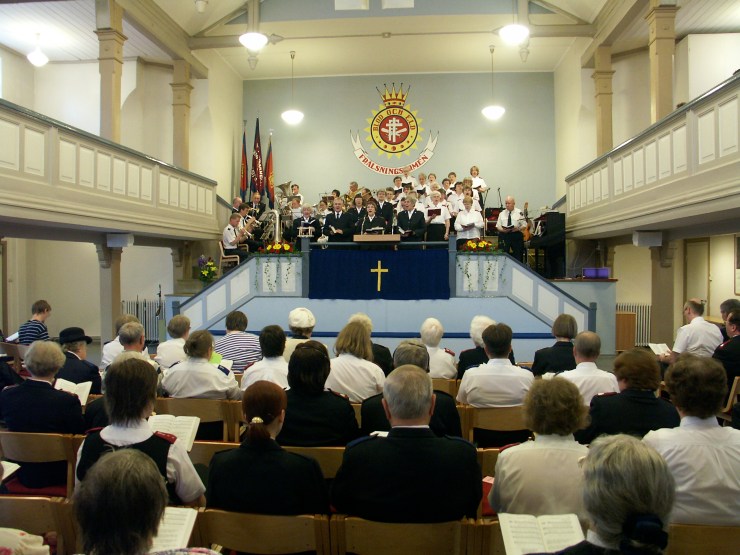
Corporate worship is essential because it can create fellowship. God has called us to fellowship, not just to gather around, but to share in fellowship. This is why we want to share in worship to have this unique experience. It is not possible to make a fixed model for how to create this fellowship. All the components of a worship service, such as fine united singing, music, profound preaching, relevant testimonies, time for prayer and reflection might be there, but still true fellowship might be lacking. We might be present as isolated individuals without any sense of belonging to each other. It is the attitude to fellowship that helps creating true fellowship. Such an attitude involves openness towards God and each other, a willingness to share, to be vulnerable, and to be challenged. It involves love for God’s people and for the fellowship he has given, a love for His worldand an urgent desire to be in the presence of God as part of his people.
Just one short sentence needs to be there to create true worship, the words of faith, hope and love – Maranata – Lord come!
 Salvationist viewpoints