That which was from the beginning, which we have heard, which we have seen with our own eyes, which we have looked at and our hands have touched – the word of life. (1 John 1.1)
In this verse from John’s letter I see the vision of an educated Army expressed very vividly. The wide Spectra of our senses is represented. What we could call the ’far’ senses such as seeing and hearing are here. They are very powerful, and what we see and hear are considered to give sufficient proof to any testimony, either it is given in the courtroom or we give it as part of our mission. They influence our lives tremendously, the light during the year, the seasons, our surroundings, all the different sounds of the day and the night, to see and hear our love ones. Even though they are very powerful we can still avoid getting deeply involved in our faith, in life, in other people, if we only use these senses. Therefore the ’near’ sense of touching mentioned here is so important, it represents the other ’near’ senses of taste and smell and points to the necessity of involvement with our whole being. We are not only witnessing to what is going on, we are participants in God’s salvation story.
I The vision
- The word of life
Translations of the last part of the verse differs, so the content in which word of life/ logos stand comes across in different ways. In Greek it stands on its own without a verb as an explanation of what was from the beginning. A translation could be ‘about the word of life’. In NTV it is translated’ this we proclaim concerning the Word of life’ and by this the translator inserts our mission into the context. By doing this the focus has been taken from what is a strong description of what we experienced and how we experienced this.
Translations like that can move the attention from the very foundation of our life and faith to the function. It is a temptation that goes beyond this case and is a general one in our Christian life. One which we are very familiar with both individually and as an Army.
The importance is this logos, this word, which was from the beginning. I don’t think we can read these words without connecting them to the well-known words from the Gospel of John – In the beginning was the Word, and the Word was with God, and the Word was God.
Our foundation and our focus should always be this. Through the logos/ word the world came into being – the Word creates at all times, in the past it created, today it creates and, in the future, it will create. Through the Word, Jesus Christ we found salvation, the Word that saves at all times, in the past it saved, at present it saves and in the future it will save.
My vision of an educated Army is that it always will keep the Word of life in focus as a fountain of creation and salvation, and that it will resist the temptation of altering our focus from the foundation of life to our function.
That which was from the beginning
I have a vision of an Army which does not built on fragmented parts, but is rooted in history and in all its life and activity breathes history. An Army that keeps and gains a strong sense of past, present and future as belonging together, as undividable.
The past or the history should not be a lexicon, but a natural part on which we built creatively, because we know it so well that it is an integral part of us. In this way it does not constrain us or block new paths, but sets us free. The freedom comes from knowing its richness so well, that it gives us plenty of ‘building’ material for digging new land and building new houses for the future. This freedom of knowledge helps us to keep our vision clear, to hold unto the foundation and not to go astray.
Example: I have got roots in two countries, the one of my father, Iceland, and the one of my mother, Denmark. When I was four I was bilingual, but I then lost the old saga language of Iceland, when we moved to Denmark. I can still sense it, hear the tone and music, understand a little, but as a construction it has gone. In later years I have had the privilege to visit Iceland frequently for shorter or longer periods. I have had opportunity to visit old family places. The cost of the firth – Eyjafjorden- where the little farmhouse was situated and where there has been a farm since the years between 800 and 900, perhaps all the years my family have been living there. I have the name of the first settler on Iceland, Ingolfr Arnarsson, and my family originates from him. The firth leads into the Artic Sea. They were small holders and fishers (and earlier Vikings). On the pages of the book of our family record I can see the were lay ministers, lay preachers, a number of them. Preaching in these tiny little churches built of grass and earth and very little timber, standing at the cost sensing history, ‘seeing’ all the generations passing by, even using a day out at the Artic Sea in extreme rough weather in a little boat I felt history with my body and soul. All this means that I have taken hold of my history – it has become my story. Because of that I have freedom, ‘building’ material and a solid foundation, even my lost language is part of that material.
This is what I mean by being rooted in history and by ‘breathing’ history.
To get this freedom we need a profound knowledge of Scripture, of church history, of world history, of Army history and of the development of the Christian faith. This protects us from the illusion that we have invented the wheel. Instead we realise that we perhaps are turning the wheel in another direction, or making a new design of what is already there. This knowledge must be part of a social memory and must not be buried as a social amnesia. A social memory can be a driving force into the future.
I have a vision of our worship being rooted deeply in history where we are making use of the richness which centuries of worship experience offer to satisfy the hunger for true worship which relates to a contemporary world.
I see fellowships being rooted in history and on that base be developed to bridge the gap of isolation to modern man.
I see theological thinking rooted in the past giving answers that satisfy the questions of today.
I see that by relating to the past we are able to relate to the future and to the present time.
Which we have heard
In the protestant tradition to which we belong, the focus has always been on the word – the preaching of the word/ the listening to the word. Sometimes this focus has led to the exclusion of spirituality connected to the other senses. In between it has impoverished the Christian experience to a very dry or one-sided Christianity which could satisfy our deepest hunger. That there has been a tendency in the protestant tradition to forget the bigger picture does not mean that we shall turn away from this focus – it just must be widened.

An educated Army is an Army who has heard the story of Salvation, the story of the Word again and again, who treasures this story, who continues to tell it and who develops an ability to listen to the story of the Word of life.
Part of the education in listening is to develop an ability to imagine for oneself what is being told, to nourish a rich inner world. My favourite story is the story of the Road to Emmaus from the gospel of Luke. It is rich, it is deeply moving and I can picture any detail in my head when I hear the words. Any film, however good based on this story, will be a poor exchange for the ‘real thing’ of my imagination sparked of by the story. Educated in this way we will not be so easy to manipulate, because the words we have been listening to, feed our imagination and develop our thoughts.
In the Army we have developed a strong tradition of communicating the Word of Life through music, to express and receive spiritual nourishment through this. The value of this heritage can hardly be overestimated. An educated Army continues to honour this heritage by keeping it vital in Army life and witness.
Example: For me the true beat of the Army music will always be ¾. This is the typical beat for many Scandinavian songs and it goes well with the guitar. I have fallen asleep to that beat as a child (as corps officers my parents with us lived in a flat on top of the hall where ever they were stationed) and I have awakened to it as well. But this beat transcended the world of music and for me became the heartbeat of the Army – faith, hope and love – Father, Son and Holy Spirit – red, yellow and blue.
Which we have seen with our own eyes
The important thing here is to be an eyewitness, to see for ourselves.
I think the most powerful influence we encounter happens through our eyes. In today’s world we are bombarded through our sight, and we know full well how easily we can be manipulated, because we believe in what we see in the pictures. I remember watching CNN and Euro News in Moscow in the autumn of 1998 when the economy and Rubel collapsed. The programs showed long queues of people standing in front of empty shops. They were old pictures from before the collapse of the Soviet Union, the buildings had by 1998 been renovated and people didn’t queue up in that way. There was an atmosphere of hectic shopping of all goods, especially gold and silver, but also food, because the Rubel by the next day would be much less in value, so people tried to use their Rubel’s or exchange them for dollars. The crisis could be seen after the hectic shopping in utter lostness and despair not knowing what the future would bring.
We must learn to discern the picture from the television as well as the social media and sort fake news out. In this world of pictures, we must learn to focus on the essentials, to focus on the cross, on the Word of Life. To have our eyes opened means to understand, to gain insight, to see the invisible in the visible, to see light in darkness. The eyes of faith need to be trained in being able to see beyond, to have visions!
When you enter an Orthodox Church, you are overwhelmed by the beauty of the icons, there are so much to see. Without training in this tradition, you only see the icons and try to figure out what they present, but by watching people you realise that they see far more. They see through the icons to another reality. They see Jesus, they see the glory of God, they see the Word of Life. It was a great privilege to watch Rublev’s icon of the trinity, the details of the colours and how it transcended a message and a spiritual reality.
An educated Army sees much more that plain reality, it sees the full-grown tree in the seed. It sees the wonders and possibilities.
Which we have looked at
The root of the word is the same as used in the theatre, where we watch, discern, become aware of things, start reflecting, come to an understanding. We see things in perspective and have the possibility for the broader picture, for an ‘over’ view.
In the book of Jeremiah chapter 1 verses 12- 14 Jeremiah is asked to look around and notice things, the branch from an almond tree and the boiling pot tilting away from the north. They cause his reflection. The Lord asks him to watch and then to reflect. The almond tree – to be alert – God is alert and will fulfil his word. The pot – the direction and out spilling of disaster.
An educated Army watches, notices and gets things in perspective to be able to reflect. By this it gets in the habit of reflecting!
Our hands have touched
The word means to touch, handle, grope after, reach out after.
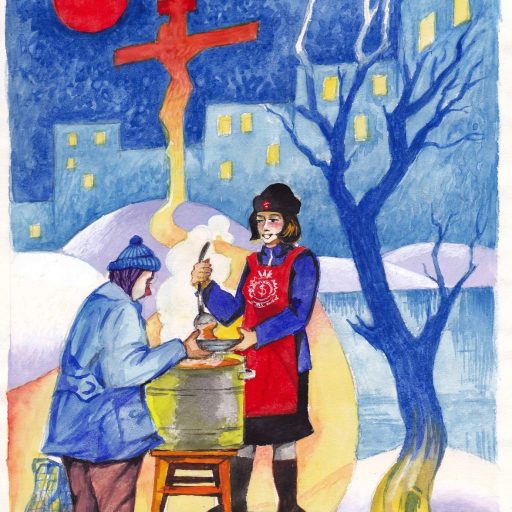
When we lived in Moscow I was at the stations in December just before Christmas with a photographer. The Army had the feeding of homeless people in two places every day, and I had often been there just to watch, talk with people and see how things were going. This day I was asked to give out the soup. It was minus 20 degrees celsius and the line of homeless was very long. By touching the dirty bottles, the homeless brought for the soup, the hot soup spilling over on my hand and the freezing cold, my experience went far beyond the one I had at times when I was only watching and listening. With my body I felt the curse of homelessness and the blessing of the soup.

An educated Army must be given the opportunity of touching, of using its hands in many situations.
To give the reality of the resurrection to the disciples, Jesus said: feel me,….. touch me. An educated Army must be touched by God, the living Word, touched by the world, touched by people and with this as a basis it will dare to touch.
How does this vision come true
We need many different avenues to facilitate opportunities to have our senses sharpened through teaching, through worship and through service. We must develop an awareness for the need of that.
An educated mind
There has been and still is some suspicion in Army circles of intellectualism, as if it was opposing genuine faith. The outcome of this has to a certain extend been that we have neglected to focus upon the necessity of an educated mind. In the future I see this focus change so we will facilitate a good basic knowledge as a foundation for creative thinking and reflection. Here it is vital that there is freedom and that we don’t en force censorship on each other. It is crushing.
An appreciation of emotions (not sentimentality)
There has been a danger in the Army of an abuse of emotions, of feelings, of sentimentality especially in bigger gatherings. As an outcome a fear of emotions has developed, and we have restricted the venues for expressing our emotions. Part of this restriction has been the fear of losing control. Emotions are difficult to control and to be sure that things go as we want them to go, we try to avoid emotions.
Abuse does not justify lack of use. We need to appreciate and educate and give possibilities to express emotions through prayer, worship and actions. There is a danger of qualifying emotions as: joy is good, sorrow is bad, contentment is good, anger is bad, love is good, hate is bad etc. etc. By this we ignore the powers in the feelings which we will not accept. We can learn through the Psalms the value of bringing all of our emotions into worship and prayer.
The greatest danger is not anger, but indifference.
Venues for developing spirituality
Worship settings – study groups – retreats. The art of praise, prayer, meditation has to be learned, we are not born with these skills. We can all cry out our need of God, but for nourishing our spiritual life we need tools.
In a time where we are bombarded with impressions, there is one tool, which even though it is hard to learn, is important. It is quietness, stillness and we need to develop abilities for that. We can develop an attitude that our whole life is worship, our work, our leisure time, our relationships to safeguard against a division between spiritual life and everyday life.
An outcome of an educated mind, educated spirituality, educated senses and emotions are creativity and energy. We must make room for this creativity. It is not enough to develop an educated Army if we don’t make room for it to express itself. There must be room for creative thinking, attempts to cross the limits of our faith and practice, for art in our worship, in our buildings, for music, for dance, drama and for literature, and for all the creativity developing through modern technology.
An open door to the ‘world’ is another important aspect. We have a history of embracing this ‘world’ and it is vital to keep this heritage alive. In spite of this heritage that has been and still is hostility towards ‘worldly’ matters. There are very few Salvationist politicians, environmentalists etc. few actors and actresses, dancers, footballers etc. It seems to have been considered better to work with money, trade, business, teaching, nursing than the other things.
Modern technology we are embracing and rightly so. We need to be alert to the possibilities as well as the dangers of this new world. It has a fascination of its own which can make people hostage to a virtual reality.
The outcome of an educated Army should be the words from Acts 4. 20: “For we cannot help speaking about what we have seen and heard (touched, tasted, smelled).
Conclusion The main heading for my vision of en educated Army is an Army marked by wisdom. In Proverbs 9.10 we read: The fear of the Lord is the beginning of wisdom and knowledge of the Holy one is understanding
(Featur Image: Brengle Institute Nairobi, Kenya – 2007)
 Salvationist viewpoints